


Most trade show booths get noticed. Far fewer get remembered.
There’s a difference, and it matters more than most exhibitors realize. Getting noticed means someone stopped. Getting remembered means the experience stayed with them after the show was over, and your brand became connected to something that felt genuinely different from everything else on the floor.
So what separates the two?
Andrew Childers, Director of Business Development at Exhibit Happy by Steelhead, shared his perspective on this at the Experiential Marketing Summit 2026.
It comes down to six principles that many exhibitors overlook, not because they’re complicated, but because they require intentional decisions most teams don’t make early enough.
Here’s what he had to say.
1. Embellishment Matters
The instinct in exhibit design is often to simplify. Clean lines, minimal copy, nothing too extra.
And while clarity matters, stripping everything back to the functional minimum leaves a lot of value on the table.
The details, textures, and finishing touches that didn’t strictly need to be there are what make a space feel considered rather than simply constructed. People notice that level of care, even if they can’t immediately explain why.
The exhibits that stick in people’s minds are rarely the ones that played it safe. They’re the ones where someone clearly went further than they had to.
Tactical Takeaways: Embellishment as Strategy
- Move Beyond the Functional Minimum: High-budget attendees (VPs and CMOs) equate "care in the details" with "care in the partnership"; a stripped-back booth risks looking transactional rather than experiential
- Textures Drive Trust: Incorporating industrial and urban textures like wood, metal, or architectural layering creates an environment that feels intentional and high-end, rather than a generic rental
- Details are Differentiation: In a hall of 13,000 annual U.S. trade shows, "the extra mile" is the only way to capture the 13 minutes of attention an average attendee spends at a targeted booth
- Strategic Layering: Embellishment isn't about clutter; it’s about using brand signals (like channel-lit logos or vivid pops of color) to ensure your brand stands apart as the definitive anchor of the show floor
2. Your Brain Loves Multiplicity
A single strong element can make an impression. But multiple elements working together? That’s what creates an experience worth spending time in.
The brain responds to richness, layered visuals, varied textures, and different points of interaction. A space with multiple points of engagement gives attendees more reasons to stay and explore.
This isn’t an argument for clutter. It’s an argument for thoughtful variety, where different elements reinforce the same overall story from different angles.
Tactical Takeaways: Your Brain Loves Multiplicity
- Multiple Touchpoints Keep People Engaged: Attendees are more likely to stay longer when there are multiple ways to interact with the space.
- Variety Creates Curiosity: Layered visuals, textures, and experiences naturally encourage exploration.
- Richness Matters More Than Minimalism Alone: Clean design matters, but overly stripped-back environments can feel forgettable.
- Every Element Should Support the Same Story: The strongest exhibits use different elements to reinforce one clear message rather than competing for attention.
3. Be Unexpected
On a show floor where many exhibits follow a familiar formula, the ones that break from it tend to stop people mid-stride.
Being unexpected doesn’t require a massive budget or a radical concept. It starts with one honest question before design begins: What would no one expect to see here, and how could that surprise actually work in our favor?
It might be an unconventional format, an unusual material, or a concept that completely reframes what a trade show presence can look like.
Client Example: Exhibit Happy by Steelhead @ Experiential Marketing Summit
The Exhibit Happy by Steelhead newsstand at Experiential Marketing Summit is a strong example of this principle in action. On a trade show floor filled with polished booths, LED walls, and predictable lounge setups, nobody expected to encounter a fully branded vintage-style newsstand. That’s exactly why it worked.
The concept immediately disrupted expectations. Instead of feeling like another exhibit attendees should “walk into,” it felt like something they had stumbled upon organically in the middle of a city street. The familiarity of the format drew people in, while the unexpected placement on the show floor made them pause long enough to engage.
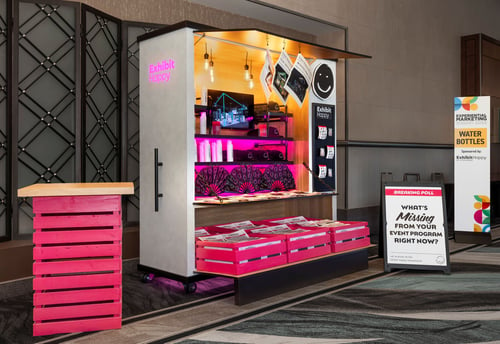
Exhibit Happy’s newsstand concept at the Experiential Marketing Summit 2026 is a simple but unexpected idea designed to stop people mid-stride and create curiosity on the show floor.
But the success of the activation wasn’t just about novelty. The newsstand format created a natural opportunity for interaction, storytelling, and conversation. It transformed the booth from a static branded space into an experience people wanted to photograph, talk about, and remember afterward.
That’s the power of strategic surprise. When something feels genuinely different — yet still intentional and connected to the brand — it earns attention in a way traditional exhibit tactics often can’t.
Tactical Takeaways: Be Unexpected
- Unexpected Moments Interrupt Patterns: Most trade show floors follow similar visual formulas. Breaking that pattern is what gets people to stop.
- Surprise Doesn’t Have to Be Expensive: Some of the most memorable ideas are also the simplest.
- Originality Creates Conversation: People are more likely to talk about experiences they didn’t see coming.
- The Goal Isn’t Shock Value: The best unexpected ideas still feel connected to the brand and the story being told.
4. Yes, Size Really Does Matter
Scale creates impact in ways that detail alone can’t replicate.
A large, well-executed element commands attention from across the room and pulls people in before they’ve consciously decided to engage. It shapes the experience before a single conversation even begins.
The question worth asking is: what element in your exhibit deserves to be bigger, bolder, or more prominent than it currently is?
Usually, it’s the thing your audience should notice first and the thing they’ll remember later.
Tactical Takeaways: Yes, Size Really Does Matter
- Scale Naturally Pulls Attention: Large visual elements create impact before a conversation even starts.
- Hierarchy Helps Guide the Experience: The most important element in the booth should also be the easiest to notice.
- Bigger Isn’t About Excess: Strategic scale creates clarity, not clutter.
- What People Notice First Often Becomes What They Remember: Strong focal points help shape the entire booth experience.
5. Leverage Neuro-Architecture
Neuro-architecture is the study of how physical spaces affect the way people think, feel, and behave.
And while the term sounds technical, the application is surprisingly practical in trade show design.
Ceiling height changes how open or intimate a space feels. Lighting shapes mood before anyone says a word. Flow determines how naturally people move through the environment. Entry points create first impressions that influence everything that follows.
When these decisions are made intentionally, not just for aesthetics, but for how the space will actually feel to someone walking through it, the experience becomes easier to engage with.
When that happens, the experience feels natural instead of forced.
Tactical Takeaways: Leverage Neuro-Architecture
- The Environment Shapes Behavior: Lighting, spacing, ceiling height, and flow all influence how attendees move through a booth.
- Good Design Should Feel Intuitive: The best experiences feel easy to engage with rather than overly designed or forced.
- Mood Starts Before Conversation: People form impressions of a space long before anyone speaks to them.
- Small Spatial Decisions Have a Big Impact: Even subtle design choices can influence comfort, curiosity, and engagement.
6. Anchor in a Key Element, Then Expand the Context
This may be the most useful principle of all.
Start with one clear, recognizable element, something specific that immediately communicates what your brand is about. Then build outward from there, layering in details and context that deepen the story.
Each element expands the world of the one before it.
In exhibit design, the same principle applies. Find the anchor point your audience should connect with first, then build an experience around it that reinforces and expands the idea over time.
Client Example: Violife @ Natural Products West
Andrew illustrated this with a recent client project. In partnership with the creative minds at 321Go, Exhibit Happy by Steelhead designed an immersive space for Violife to spotlight their plant-based cream cheese.
When people think of cream cheese, their minds naturally go to bagels — and from there, New York City. Most event marketers stop at that obvious connection. But memorable experiences are built by going one step further.
So we expanded the narrative:
Cream Cheese → Bagels → New York City → Subways → Subway Street Performers
That final leap transformed the booth from a simple-themed environment into a layered, memorable experience that surprised attendees and deepened their emotional connection to the brand.
That’s the difference between a booth that makes a single point and an experience that feels fully developed.
Tactical Takeaways: Anchor in a Key Element, Then Expand the Context
- Start With One Clear Idea: The strongest exhibit experiences usually begin with a single recognizable concept.
- Build Layers Around the Anchor: Supporting details help deepen the story and make the experience feel more complete.
- Context Creates Emotional Connection: People engage more deeply when an experience feels immersive rather than isolated.
- The Best Exhibits Feel Cohesive: Every element should feel connected to the larger idea the brand is trying to communicate.
The Common Thread
Look across all six of these ideas, and a pattern starts to emerge: memorable trade show experiences don’t happen accidentally.
They’re the result of intentional decisions made early, before the first design concept ever hits the screen.
Embellishment, multiplicity, surprise, scale, psychology, and narrative aren’t decorative considerations. They’re strategic ones.
And when they work together, the result isn’t just a booth people notice.
It’s an experience they remember.
Where Exhibit Happy Comes In
Knowing the principles is one thing. Applying them in a real exhibit with real timelines, budgets, and business goals is where the work actually begins.
At Exhibit Happy by Steelhead, we help brands translate these ideas into experiences that feel intentional from the first interaction to the last conversation on the show floor. The goal isn’t just to create something people notice. It’s to create something they remember for the right reasons.
Because the most effective exhibits don’t happen by accident. They’re built through thoughtful decisions that shape how people experience your brand in real time.