


Trade shows reward preparation. Not the kind that starts two weeks out when the deadline gets real, the kind that starts with a clear plan, built early enough for your team to execute it well.
But for modern marketing teams, the pressure is different than it used to be. Budgets are tighter, teams are leaner, and leadership expects trade show results to connect back to the pipeline in ways that are clear and defensible. At the same time, trade shows are being planned alongside digital campaigns, social pushes, and content calendars that don't pause because a show is coming up.
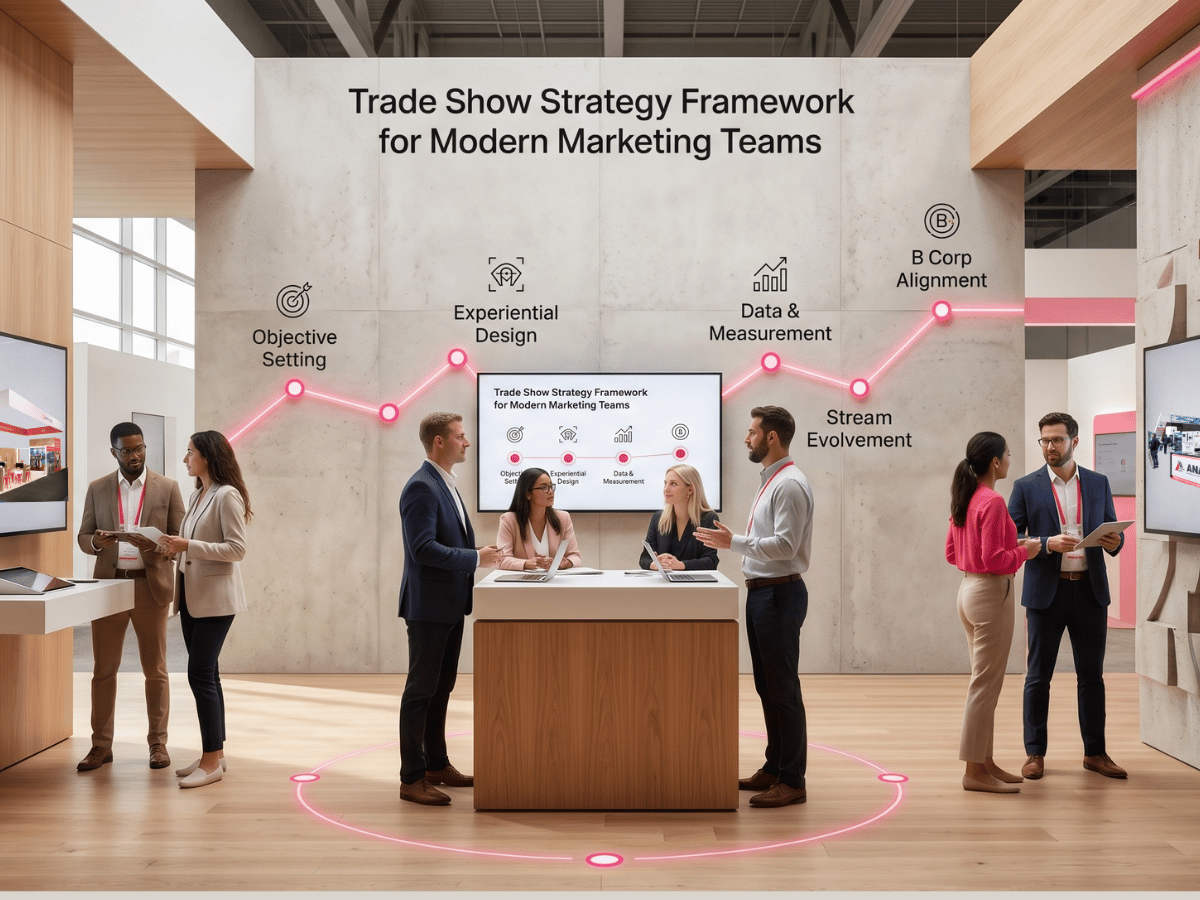
Most trade show stress isn't inevitable. It's the result of strategy being treated as something to figure out later. This framework is designed to change that, giving modern marketing teams a repeatable approach they can build on show after show.
Why Modern Marketing Teams Need a Framework More Than Ever
The trade show landscape hasn't gotten simpler. If anything, the expectations around it have grown.
Marketing teams today are expected to prove ROI with data, integrate trade show activity with CRM and digital campaigns, and do it all with fewer dedicated resources than their predecessors had. Meanwhile, the competition on the show floor is more sophisticated, better designed, better staffed, and better prepared than ever.
A clear framework doesn't just reduce stress. It gives teams a way to plan smarter, execute consistently, and report results in a language that resonates with leadership. It also makes the whole process more transferable, so institutional knowledge doesn't walk out the door when team members change.
Step 1: Define the Objective
Before anything else gets decided, your team needs one clear answer to this question: what is this show for?
Not a list of hopes. One primary objective.
That might be generating a specific number of qualified sales conversations. It might be launching a product to a targeted audience. It might be deepening relationships with a handful of key accounts. Whatever it is, it should be specific enough that at the end of the show, you can look at it and say yes or no.
Everything else, booth design, staffing, messaging, follow-up, flows from that answer.
Step 2: Work Backward From the Show Date
Once the objective is set, map out the timeline in reverse.
Start with the show date and work backward, identifying every decision that needs to be made and when it needs to be made by. This usually reveals two things: how little time there actually is, and how many decisions are dependent on other decisions being made first.
A few questions to work through at this stage:
- When does the exhibit need to ship, and what needs to be finalized before that happens?
- When do staff need to be confirmed and briefed?
- When does pre-show outreach need to go out to be relevant by the time the show opens?
- What approvals are in the critical path, and who owns them?
Getting this on paper early, even roughly, prevents the last-minute scramble that turns show week into a stress test.
Step 3: Build the Exhibit Around the Objective, Not the Other Way Around
This is where a lot of trade show strategies fall apart.
The exhibit gets designed first, and the strategy gets layered in later. The result is a space that looks great but doesn't fully support how the team needs to engage or the conversations they're trying to have.
Before locking in design direction, answer these questions:
- What does a successful interaction in this space look like from start to finish?
- What do you want someone to walk away knowing, feeling, or doing?
- How many people do you need to be able to engage at once?
- What's the one thing this exhibit needs to communicate clearly from 20 feet away?
When the exhibit is built around the answers to those questions, it becomes a tool for your strategy rather than a backdrop for it.
Step 4: Align the Team Before You Arrive
A well-designed exhibit with a misaligned team is still a missed opportunity.
Before the show, everyone who will be on the floor, whether that's two people or twenty, needs to be aligned on the same things:
- What's the primary objective, and how does each person's role support it?
- What's the messaging, and how should it be communicated consistently?
- What does a qualified conversation look like, and how should leads be captured?
- What are the boundaries of what the team is empowered to offer or decide on-site?
This doesn't need to be a lengthy training session, but it does need to happen, clearly and early enough that it actually sticks by the time the show opens.
Step 5: Plan the Follow-Up Before You Leave
Follow-up is where most trade show value either gets captured or quietly disappears.
The mistake most teams make is treating follow-up as something to figure out after the show. By that point, momentum has faded, inboxes have refilled, and the leads that felt urgent on Thursday feel a lot less urgent by the following Tuesday.
Plan the follow-up before you leave for the show:
- What does the first outreach look like, and who sends it?
- How quickly does it go out after the show closes?
- How are leads segmented, and does follow-up differ based on the type of conversation?
- What's the handoff process between marketing and sales?
For modern marketing teams, this is also the moment to think about how trade show leads feed into your CRM and connect to the digital campaigns already running. A lead captured on the show floor shouldn't feel like it exists in a separate system; it should slot right into the broader pipeline your team is already managing.
Having that ready in advance means your team can execute immediately, while the conversations are still fresh and the connection still feels recent.
Step 6: Measure Against the Objective You Set
Circle back to step one.
Whatever objective you defined at the start, now is the time to evaluate against it honestly. Did you hit it? If yes, what made the difference? If not, where did things break down?
This is also the moment to look beyond the headline numbers. Lead count and booth traffic are easy to report, but not always the most useful data. Better questions to ask:
- How many conversations matched your target audience profile?
- What percentage of leads are being actively pursued by sales?
- Were there moments where messaging fell flat or resonated unexpectedly well?
- What would you do differently with two more weeks of preparation?
For teams reporting to data-driven leadership, this step is also where you connect trade show outcomes back to broader campaign performance, showing how the event contributed to the pipeline, not just how many badges got scanned.
The teams that improve fastest aren't the ones with the biggest budgets. They're the ones who debrief honestly and apply what they learned.
Keep the Framework, Improve the Execution
No approach is perfect the first time through. What matters is having a consistent structure you can actually build on.
When the framework stays the same from show to show, patterns become easier to spot, and improvements become easier to make. Over time, trade shows stop feeling like something your team survives and start feeling like something they're genuinely good at.
That’s when trade shows start to feel more predictable and far more effective.
Where Exhibit Happy by Steelhead Comes In
Having a framework is one thing. Having the right partner to help you execute it is another.
At Exhibit Happy by Steelhead, we work with marketing teams to make sure strategy and execution are actually aligned, from early planning through what shows up on the trade show floor. The goal isn’t to reinvent the process each time, but to build on what works and improve it over time.
Because a strong trade show presence shouldn’t rely on last-minute adjustments. It should come from a plan your team can execute with confidence.