


Published November 12, 2026
Choosing an exhibit partner for 2027? You want to compare your options fairly and feel confident in the team you choose. A thoughtful RFI and RFP process can help you get there by giving you and potential partners time to learn about each other before moving into proposals.
Where a search can go sideways is when everything lands in one long request sent to a long list. Warehouse locations and insurance levels get mixed in with booth concepts and pricing, strong suppliers may pass on a crowded bid, and the ones who respond have had little chance to learn your goals before they start designing.
At Exhibit Happy by Steelhead, we see a lot of RFIs and RFPs, and we know how much thought goes into choosing a new partner. Here's when to use each one, how many suppliers to invite, and how to make room for the conversations that help you find the right fit.
In this article:
- What's the Difference Between an RFI and an RFP?
- Why Should You Separate the RFI From the RFP?
- How Many Suppliers Should Get Your RFP?
- What Do Most Exhibit RFPs Miss?
- How Do You Keep Strong Partners in Your Search?
The Quick Answer
- Start with an RFI to confirm fit. Use a request for information to learn which suppliers have the capabilities, facilities, and insurance coverage your exhibit program requires.
- Use an RFP to compare approaches. Invite qualified suppliers to explain how they would deliver on your goals, with a clear brief, budget range, and evaluation criteria.
- Keep creative requests focused. When your RFP includes custom booth concepts, we recommend inviting three suppliers, and no more than five, so you have time to engage with each team and thoughtfully review its proposal.
- Meet the team before you choose. Build in opportunities to meet the team you'd work with and understand how they communicate, collaborate, and approach your questions.
What's the Difference Between an RFI and an RFP?
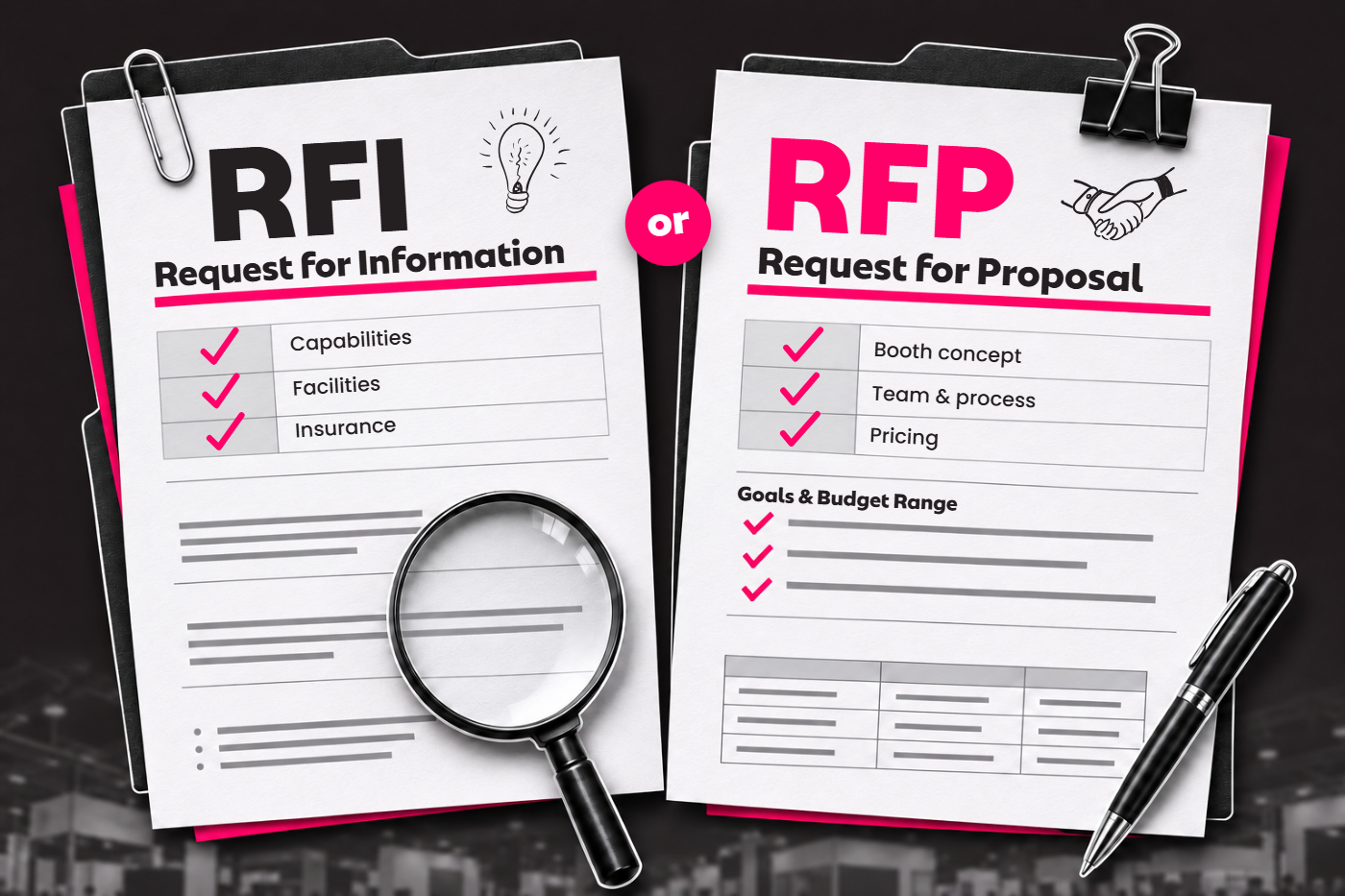
An RFI helps you learn which exhibit partners could meet your needs. An RFP asks qualified suppliers how they would approach your specific show or program. NASPO, the National Association of State Procurement Officials, describes an RFI as non-binding and notes that RFIs "do not typically require price or cost from suppliers," which makes them a low-pressure way to learn about the field.
For an exhibit partner search, the RFI covers the fundamentals, like capabilities, facilities, and insurance requirements. When we asked our CEO, Sean Combs, about RFIs on Inside Exhibit Happy, he said he wishes procurement teams used them more broadly, since an RFI can go to 10 to 15 companies to confirm whether "the bones of the operation" suit what you're looking for. That gives you room to explore your options before narrowing the field.
The RFP builds on what you've learned. You share your objectives, budget range, and what matters most in a partner, and ask shortlisted suppliers to show how they would approach your show, usually with a custom booth concept and pricing. Because that takes real time and creative effort on both sides, your questions should also help you understand the supplier's process and the team you would work with.
| RFI: Request for Information | RFP: Request for Proposal | |
|---|---|---|
| Main question | Can this company support our program? | How would this company approach our program? |
| Who receives it | A broader group of potential partners | A shortlist of qualified suppliers |
| What you explore | Capabilities, facilities, and insurance | Creative, pricing, process, and team |
| Custom creative | Save project-specific concepts for the RFP | Usually included |
If you're deciding what to include in your brief, our guide to building a better exhibit RFP covers the goals, budget details, and questions that help suppliers give you a useful response.
Why Should You Separate the RFI From the RFP?
Separating the two gives your procurement, brand, and event teams time to agree on priorities and the requirements a partner needs to meet before you begin comparing proposals.
Sean gave a practical example: a supplier could develop a strong booth concept, only for its warehouse location to become the deciding factor. If location is a requirement, addressing it during the RFI helps both teams focus their time on opportunities that fit.
With those fundamentals settled, the RFP gives you more room to discuss your goals and explore each supplier's approach. Sharing your evaluation criteria up front helps, too, so suppliers know what will weigh most in your decision. Your team can review proposals knowing that the companies behind them already meet your core requirements, and suppliers can put more thought into how they would support your show.
How Many Suppliers Should Get Your RFP?
When your RFP includes custom creative, we recommend keeping your shortlist to three suppliers, and no more than five. A smaller group gives your team time to meet with each supplier, answer their questions, and give every proposal the attention it deserves.
That time pays off on both sides. As Sean puts it, when suppliers can engage with your team and learn your real objectives, the concepts they bring back are more intentional and built around what you're trying to accomplish.
There's a supplier side to this, too. We reserve the bulk of our creative capacity for our clients, and Sean points out that's exactly what you'd want as a client: a team that can respond quickly to your needs. When an RFP goes to too many suppliers, a strong partner may decide not to respond, and in this clip, Sean explains why he'd hate to see that happen to event planners.
Use the RFI to explore broadly, then invite the few teams you most want to get to know. You'll come away with a clearer picture of what each could bring to your program.
Planning a partner search for 2027? Let's talk through what your RFI and RFP should cover.
What Do Most Exhibit RFPs Miss?
Most RFPs miss the human element. When you choose an exhibit partner, you're choosing the people you'll rely on to support an event or a full program, especially your account management team.
From our side of the process, Sean points out that RFPs often limit who suppliers can talk to and which questions they can ask, in an effort to keep things fair. As a result, we're often creating first concepts before we really know each other, and you're comparing those concepts without knowing the teams behind them.
Within your procurement guidelines, give each shortlisted supplier a comparable chance to meet your stakeholders and discuss your program. Those conversations help both sides see whether you're a good fit on a human level.
How Do You Keep Strong Partners in Your Search?
A clear brief and time for conversation help potential partners decide whether the opportunity fits and give you a more useful response. Here's how to put that into practice:
- Agree on what matters before reaching out. Bring procurement, brand, and event teams together to agree on priorities, requirements, and how you'll evaluate proposals. If you're considering a change from your current partner, our Tradeshow and Event Marketing Supplier Assessment can help you review that relationship across six areas, from service and communication to sustainability and pricing transparency, so your team can see where it's working and where it isn't.
- Use the RFI to build your shortlist. Confirm which suppliers can support your program before requesting detailed proposals. If you're asking for custom creative, aim for three qualified participants, and no more than five.
- Give suppliers a brief they can work from. Share your objectives, budget range, evaluation criteria, and timeline, including key dates. If your objectives need more definition, start with our guide to designing a booth around measurable goals.
- Plan time to meet and ask questions. Give each shortlisted team a comparable opportunity to discuss the brief with your stakeholders. A facility visit can also help you understand the people and operation behind the proposal.
- Evaluate how you work together. Alongside the proposed approach and pricing, weigh how each team worked with you during the search. Those interactions offer an early look at the partnership you're choosing.
For more ways to bring conversation and collaboration into your search, see 5 Ways to Disrupt an Outdated Event Marketing RFP System.
Where Exhibit Happy by Steelhead Comes In
Choosing an exhibit partner is a big decision, and it's where our motto shows up first: "It's not what we do; it's how we do it that matters." Here's what working with us looks like through our Proven Design Process:
- We start with your goals. We learn what you want your exhibit to accomplish, along with your show requirements and budget.
- We design with you. We review ideas and the attendee journey with you in sketch form, then develop a rendered concept with ballpark pricing.
- We walk you through the proposal. You'll see what's included and understand it before anything moves forward.
- We stand behind the price. Our Price Guarantee locks the price of Steelhead-provided services unless you approve a change in scope, and we help you plan for third-party show costs, such as drayage and electrical, that sit outside it.
That's what we mean by no surprises.
Whether you're drafting an RFI, building your shortlist, or still figuring out where to start, we'd love to help you think it through. Book a Consultation to get started.
Frequently Asked Questions
What is the difference between an RFI and an RFP for an exhibit partner?
An RFI qualifies suppliers on fundamentals like capabilities, facilities, and insurance. An RFP goes to a smaller group and asks how each would approach your show or program, usually with a custom booth concept and pricing.
How many exhibit houses should get an RFP?
We recommend three, and no more than five, when the RFP includes custom creative. A shortlist gives each supplier room to learn your objectives and keeps strong partners from passing on a crowded bid.
What should I include in an exhibit RFP?
Give suppliers a clear brief with your objectives, budget range, evaluation criteria, and timeline, including key dates. Being upfront about what you value helps them give you a more useful response.
What questions should I ask before choosing a custom booth vendor?
Split them across two stages. Use an RFI for qualifying questions about capabilities, facilities, and insurance, then save questions about creative, pricing, and how the team works for the shortlist that gets your RFP. For more questions to ask, see 10 Questions to Ask When Selecting a New Exhibit Provider.
What do most exhibit RFPs miss?
The human element. Suppliers are often limited in who they can talk to during an RFP, so you end up comparing first concepts without knowing the teams behind them. Build in time to meet your shortlist.
Related Posts
- You're Doing RFPs Wrong. Here's Why
- 10 Questions to Ask When Selecting a New Exhibit Provider
- 5 Ways to Disrupt an Outdated Event Marketing RFP System
Sources:
- Inside Exhibit Happy: RFI & RFP (Sean Combs), Exhibit Happy by Steelhead
- Inside Exhibit Happy: How Many Suppliers Should Get Your RFP? (Sean Combs)
- NASPO, Procurement Toolbox Issue 4: Solicitation Methods
- Exhibit Happy by Steelhead, Trade Show Strategy and Design (Proven Design Process)
- Exhibit Happy by Steelhead, What a Full-Service Exhibit Program Should Include
- Exhibit Happy by Steelhead, Exhibit Management and Price Guarantee
- Exhibit Happy by Steelhead, Tradeshow and Event Marketing Supplier Assessment