


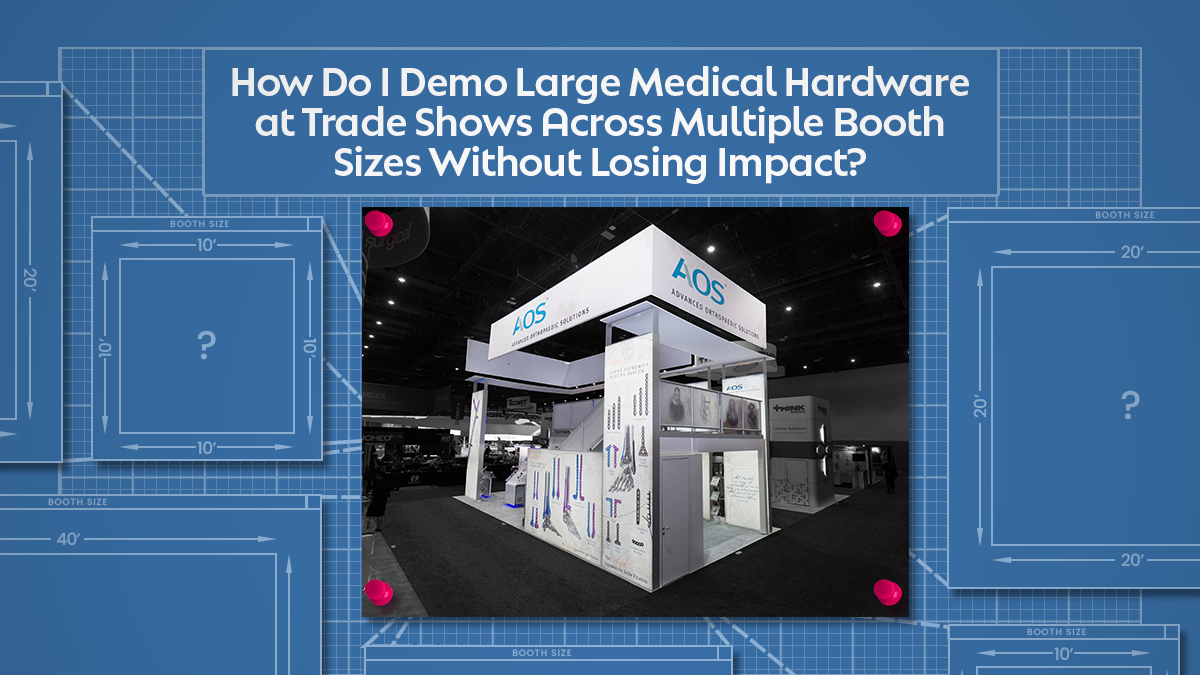
How Can MedTech Brands Scale Hardware Demos Across Different Booth Sizes?
Successful MedTech hardware demos rely on modular engineering, designing core structural systems for power, weight-bearing support, and data connectivity that can scale from a 10x10 regional seminar footprint to a 50x50 island at a major medical congress without rebuilding the technical infrastructure every time.
In MedTech exhibiting, the exhibit architecture should be built around the machine, not the other way around.
Why Is Demoing Medical Hardware at Trade Shows So Complicated?
Because medical hardware doesn’t behave like a banner stand.
An MRI system, robotic surgical platform, diagnostic imaging device, or infusion system comes with real operational requirements:
- Power
- Weight
- Connectivity
- Climate considerations
- Clinical-grade handling
Those aren’t details you can work around later. They need to be engineered into the exhibit environment from the beginning.
And the complexity grows across a multi-congress program.
The footprint at the RSNA Annual Meeting may look very different from that of a regional seminar or a smaller specialty event. The infrastructure requirements at HIMSS Global Health Conference & Exhibition may differ from those at a cardiovascular or surgical meeting.
At the same time, MedTech marketing teams still need consistency across the entire program.
That’s where medical device exhibit strategy becomes less about designing individual booths and more about building scalable systems that support the hardware wherever it goes.
And that’s exactly what modular engineering is designed to solve.
What Is Modular Engineering in MedTech Exhibit Design?
Modular engineering is the practice of designing core exhibit systems, power infrastructure, structural support, connectivity, and technology integration in a way that scales across multiple booth sizes without needing to be rebuilt each time.
Think of it as the difference between building a booth and building a platform.
A traditional booth is typically designed for one footprint. When the space changes, the structure often needs major modification.
A modular platform is different.
The same engineered systems can be configured differently depending on the event size, while still maintaining the same technical foundation.
For MedTech brands, that’s enormously practical.
The same robotic surgical system anchoring a 40x40 island at a flagship congress can leverage the same core infrastructure supporting a smaller 20x20 demonstration at a specialty meeting, without redesigning power, connectivity, or structural support each time.
That scalability is what makes modular engineering one of the most effective long-term approaches for healthcare technology demonstrations.
What Are the Biggest Logistics Challenges for Large Medical Hardware?
Before design conversations even begin, the logistics have to work.
Large medical devices introduce technical challenges that many exhibit environments simply aren’t prepared for.
Floor Load Limits
Convention center floors have strict weight limits that vary by venue and hall.
Large imaging systems, robotic platforms, and diagnostic devices can place substantial weight on a relatively small footprint, requiring:
- Load distribution planning
- Structural engineering review
- Venue approvals
- Advanced coordination with facility teams
An exhibit partner who hasn’t evaluated floor-load requirements before move-in creates exactly the kind of issue no MedTech team wants to discover onsite.
220V and Three-Phase Power Requirements
Most standard exhibit booths are wired for 110V service.
Large medical devices often require:
- 208V power
- 220V service
- Three-phase electrical drops
- Dedicated circuits
Those requirements need to be mapped against venue specifications early in the planning process, not during installation.
Once move-in begins, solving infrastructure problems becomes very expensive, very quickly.
Specialized Drayage and Equipment Handling
Standard trade show drayage isn’t always built for sensitive medical hardware.
Many devices require:
- Specialized crating
- Climate-controlled transportation
- Careful handling protocols
- Coordinated delivery schedules
And those logistics often carry significantly higher costs than standard exhibit freight.
The earlier those conversations happen, the smoother the congress experience becomes.
What Does a “Hardware-First” Design Philosophy Mean?
In many exhibit environments, the architecture comes first, and the product gets placed into it later.
In MedTech exhibiting, that order has to be reversed.
The hardware is the hero. Everything else serves it.
That means design decisions start with questions like:
- What does the device need to operate safely?
- What does the audience need to experience firsthand?
- What does the demo flow need to look like?
- What supporting content helps clinicians understand the technology?
When those questions drive the environment, the experience feels intentional instead of staged.
And sophisticated healthcare audiences notice the difference immediately.
Integrating Digital Overlays With Physical Hardware
Physical hardware tells part of the story.
Digital content extends it.
Interactive touchscreens, AR and VR overlays, procedure walkthroughs, outcomes data, and clinical visualizations all help audiences better understand how the technology fits into a real clinical workflow.
But the key is integration.
Digital experiences added as an afterthought often feel disconnected from the hardware itself.
Digital experiences designed as part of the exhibit architecture feel physically, visually, and operationally cohesive with the devices they support.
At healthcare technology events like HIMSS Global Health Conference & Exhibition and RSNA Annual Meeting, where audiences expect sophisticated engagement, that distinction matters.
How Does the Access Model Support MedTech Scalability?
One of the biggest challenges in MedTech exhibiting is balancing consistency with flexibility across an entire congress program.
A flagship congress presence needs to feel ambitious and high-impact.
A smaller regional seminar still needs to feel intentional and aligned with the same brand.
Traditional exhibit ownership makes that difficult.
A custom island built for one footprint rarely scales gracefully into another size without major modifications or additional investment.
The access model solves that differently.
Because the underlying tech-ready systems power infrastructure, connectivity, structural support, and integration points are part of a flexible inventory rather than a fixed asset, the same engineered foundation can support:
- A global congress presence
- A regional seminar
- A specialty society meeting
- or a focused inline demo
without rebuilding from scratch each time.
The experience scales.
The technology scales.
The investment scales more appropriately with the event itself.
For MedTech marketing teams managing multiple healthcare technology demonstrations throughout the year, this creates a meaningful operational advantage.
What Does “The On-Switch Works the First Time” Really Mean?
Every MedTech marketing operations leader knows the moment.
The first morning of the show.
The first clinician walking into the space.
The moment the device needs to:
- Power on
- Connect
- Function properly
- and perform exactly the way it’s supposed to
That moment is either the result of thorough preparation or it isn’t.
For Exhibit Happy by Steelhead, service and quality in MedTech exhibiting means the preparation is thorough enough that the setup itself disappears into the background.
Where Exhibit Happy by Steelhead Comes In
MedTech hardware deserves an exhibit environment built to support it properly from the very beginning.
Exhibit Happy by Steelhead works with MedTech brands to create healthcare technology demonstrations where the hardware genuinely drives the experience, from the infrastructure supporting the device to the digital systems that extend the story around it.
That includes:
- Scalable modular engineering
- Technical infrastructure planning
- Integrated digital overlays
- Congress-to-congress flexibility
- and operational preparation designed to minimize surprises onsite
Because when the on-switch works the first time, every time, your team gets to focus on what actually matters: putting the technology in front of the clinicians and decision-makers who need to experience it.
Frequently Asked Questions
What booth sizes can large medical hardware work within?
With modular engineering, medical hardware can scale from smaller inline exhibits to large island environments. The key is to design the infrastructure to scale from the beginning, rather than treating each footprint as a separate engineering project.
What power requirements do medical devices usually need at trade shows?
Many large medical devices require 208V or 220V three-phase power instead of standard 110V service. Those requirements should be mapped during planning and coordinated with venue electrical contractors well before installation begins.
What is drayage, and why does it matter for medical devices?
Drayage is the movement of exhibit materials from the loading dock to the booth space. Sensitive medical hardware often requires specialized handling, transportation, and delivery coordination to avoid damage and delays.
Can AR and VR be integrated into MedTech exhibits?
Yes, and when integrated directly into the exhibit architecture, AR and VR experiences can significantly extend how healthcare audiences engage with the technology and supporting clinical story.
What makes an exhibit “hardware-first”?
A hardware-first exhibit is designed around what the device needs to operate and what the audience needs to experience, rather than forcing the hardware into a pre-designed architectural concept
Sources:
- RSNA Annual Meeting — https://www.rsna.org/annual-meeting
- HIMSS Global Health Conference & Exhibition — https://www.himssconference.com/
- CONEXPO-CON/AGG 2026 Show Rules & Regulations (floor load limit reference) — https://www.conexpoconagg.com/CONEXPO_CON_AGG/media/CECA-Docs/Regulations/CONEXPO-CONAGG-2026-Show-Rules-Regulations.pdf
- IAEE Guidelines for Display Rules and Regulations (electrical and venue planning standards) — https://www.ncsi.com/wp-content/uploads/2019/04/iaee-guidelines-for-display.pdf
- Muller Expo, What Is Material Handling (Drayage) for Trade Shows — https://mullerexpo.com/what-is-material-handling-for-trade-shows/