


Published October 27, 2026
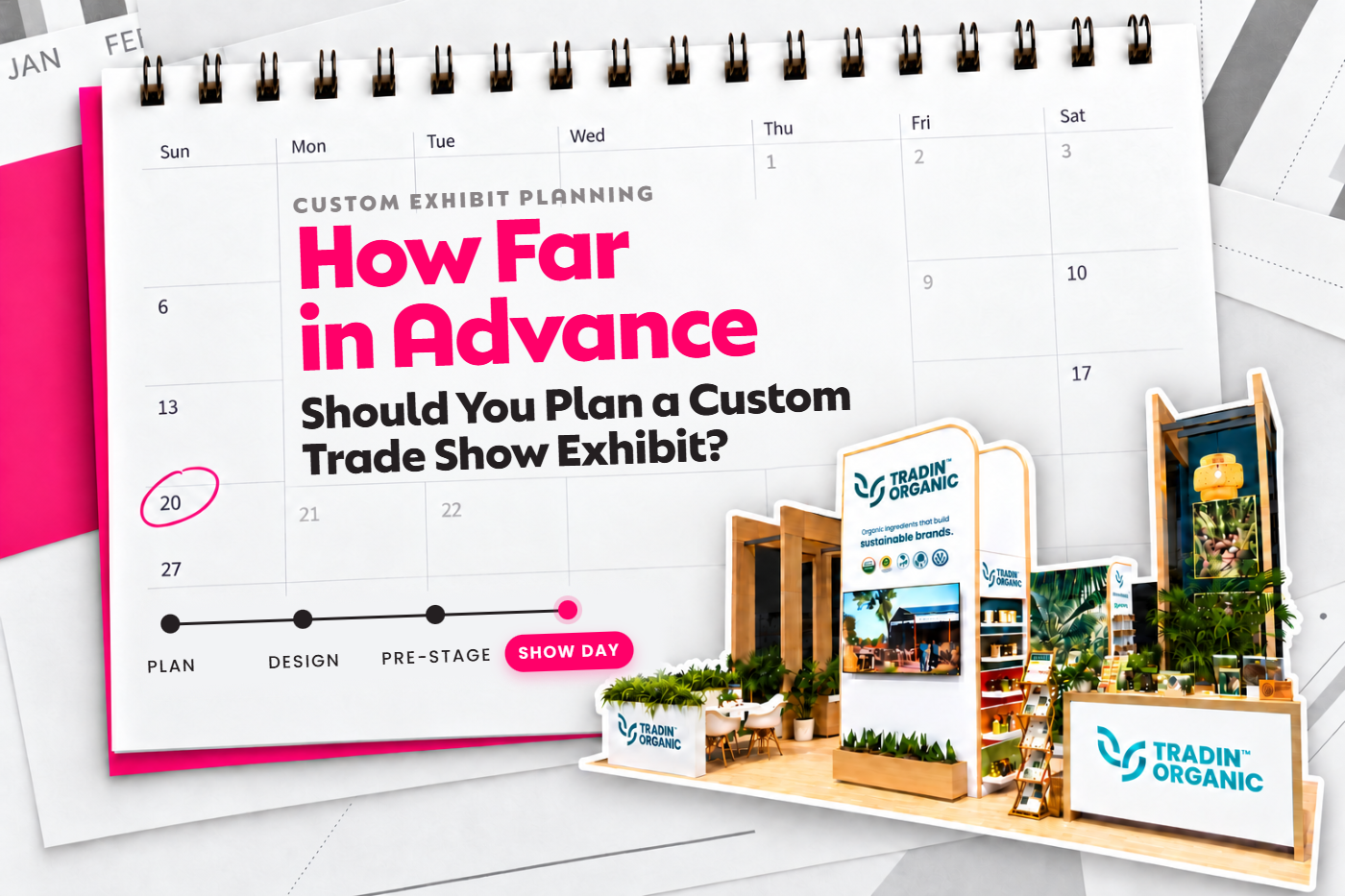
Your show date may be months away, but the decisions that shape your custom trade show exhibit start much sooner. Reserving space, choosing a partner, approving the design, and preparing graphics all need time, and each show brings its own deadlines into the mix.
Starting early gives your team room to explore ideas and work through feedback before production begins. If your timeline is shorter, understanding which deadlines have passed and which decisions still need to be made helps you focus on what's possible.
At Exhibit Happy by Steelhead, we work through those decisions with you. Here's how far in advance to start, what happens at each stage, and where pre-staging fits before your exhibit ships.
The Quick Answer
- Plan on several months, and start as early as you can. EXHIBITOR magazine's minimum is three months before your ship date for a new or rented exhibit. We find the sweet spot is four to six months.
- Book space as early as your show allows. Some shows open space sign-ups before the previous year's show even begins.
- Mark your approval deadlines early. Floor plans and hanging signs need show approval, and those forms can be due anywhere from weeks to months before opening.
- Choose a partner that pre-stages. Seeing your booth fully built before it ships gives you a chance to address issues before they're harder to fix onsite.
How Far in Advance Should You Start Planning a Custom Exhibit?
Plan on several months for a custom exhibit, and start no later than three months before your ship date, the minimum EXHIBITOR magazine recommends for a new or rented exhibit. Some shows open space sign-ups before the previous year's show even begins, so for those, your planning starts a year or more out.
How long your project takes depends on its complexity:
- New custom builds move through phases like concept development, structural engineering, graphic production, fabrication, quality control, and logistics coordination, and may span several months from initial strategy to installation.
- Modular adaptations often require shorter timelines.
- Updates to an existing exhibit, like minor changes and new graphics, can generally be done in a matter of weeks.
Beyond those minimums, start as early as you can. The earlier you start planning, the more control you'll have over every part of your exhibit, and the less likely you are to pay for rush production or missed deadlines.
Every one of those phases starts with knowing what your exhibit needs to accomplish. If your goals are still taking shape, our guide on how to design a booth around measurable goals for 2027 walks through what to define first.
What Does a Custom Trade Show Exhibit Timeline Look Like?
A custom exhibit timeline runs on two tracks: the work to design and build your exhibit, and the deadlines your show sets. Every show sets its own dates, so review your exhibitor service kit as soon as it arrives, usually four months to six weeks before the show. Here's how the key deadlines line up for NADA Show 2027.
| How far out | What's due | NADA Show 2027 date |
|---|---|---|
| About 8 months | Book your booth space | June 1, 2026 |
| About 6 months | Select your exhibit provider | August 18, 2026 |
| About 10 weeks | Submit floor plans | December 11, 2026 |
| About 6 weeks | Submit hanging sign forms | January 6, 2027 |
| About 4 weeks | Order show services at the discount rate | January 18, 2027 |
| 1 to 2 weeks | Pre-stage your booth | Before your exhibit ships |
| Show day | Exhibit hall opens | February 18, 2027 |
We also recommend setting your own deadlines a week early, especially when a discount is on the line.
The show's deadlines are only part of the picture. Behind them are design, production, shipping, installation, and on-site details that all have to come together, and that's a lot for one team to track.
At Exhibit Happy by Steelhead, we take that pressure off your team.
- We manage the work behind your exhibit, from strategy and design through fabrication, pre-staging, shipping, installation, and on-site support, so you can focus on the bigger picture.
- Your dedicated program manager builds your deadlines into one project timeline, with clear milestones and approval dates that give you time to bring in the right people.
- You stay updated every step of the way. No chasing vendors. No unclear timelines.
Our guide to what a full-service exhibit program should include breaks down what to expect from a partner.
Will I See My Booth Fully Built Before the Show?
You will if your exhibit partner pre-stages it. At Exhibit Happy by Steelhead, we fully assemble your booth in our Las Vegas showroom, typically one to two weeks before the booth ships to the show. You can walk through the environment, see how the graphics and sightlines work together, and check whether the spaces for demos and conversations feel right.
Not every exhibit partner includes pre-staging, so ask about it when you compare partners.
Some details only become clear when you're standing in the booth. An area that looked spacious in a rendering may feel tight, or a demo might work better facing another direction. Pre-staging gives us time to review those details together and address agreed changes before the exhibit ships.
It also gives our team a chance to check how everything comes together before installation. In the clip below from The Importance of Pre-Staging, Sean Combs, our CEO, calls pre-staging "our own personal dry run." It helps us deliver the fit, finish, and execution you expect while staying accountable to the price we've guaranteed.
What Gets More Expensive When You Start Late?
Starting late usually costs more in three places: production, show services, and changes made onsite.
- Rush production. When design and fabrication get compressed, rush charges can apply. In EXHIBITOR magazine's "What's the Plan?" column, Candy Adams, CTSM, warns that rush charges "can double your bill." We recommend asking your exhibit house for its internal deadlines and when rush charges go into effect.
- Missed advance deadlines. Show services ordered after the advance deadline are usually billed at standard rates, and EXHIBITOR warns that missed early-bird deadlines can mean lost vendor discounts of up to 50 percent. As a 2025 example, the material handling rate on the NAB Show New York order form was $2.68 per pound in advance and $3.35 per pound at the standard rate. Our guide to budgeting for trade show booth costs in 2027 covers how show-service charges and ordering deadlines fit into your overall budget.
- Onsite changes. Changes made once the booth is on the show floor leave less time and room to get them right. On Inside Exhibit Happy, when we asked Reece Markman, one of our account directors, how pre-staging reduces risk, he pointed out that making changes on the show floor one day before the show opens "can literally cost tens of thousands of dollars depending on what those changes are."
Planning for a 2027 show? Let's map out your deadlines together, so nothing catches your team off guard.
What If You Have Less Than Three Months to Plan Your Booth?
You still have options, as long as you move quickly. What's possible depends on your exhibit, your show's remaining deadlines, and how fast decisions get made.
The quickest way to find out is to talk it through. Share:
- Your show date and booth dimensions
- Your budget
- What you want the show to accomplish
- Any must-have features
- Where approvals stand
We'll tell you what's still possible and what it will take to get you to the show floor.
This is where our Access Model makes a difference. An exhibit you own typically locks you into a design you committed to months in advance. A custom rental gives you the flexibility to refresh your look for every show and more room to adjust when plans change late. Adam Forbes, our Business Systems Manager, compared the two models on Inside Exhibit Happy and pointed to what makes that possible: "We have an entire catalog of cabinets and modular systems that work seamlessly with each other."
Big changes can land late, too. When Seyond, formerly Innovusion, announced a full rebrand just one month before CES 2024, the new identity still had to debut on one of the industry's biggest stages. Our team helped bring it to life in a 50x70 booth so the brand showed up clearly, confidently, and consistently on the show floor.
Where Exhibit Happy by Steelhead Comes In
At Exhibit Happy by Steelhead, our Proven Design Process starts with your goals, and during the First 15, we align scope, clarify deliverables, and set timelines so your team knows what to expect.
Our Price Guarantee locks the price of the services we provide within your approved scope, from design and production through transportation, installation, and on-site support. Pre-staging lets you walk through your exhibit before it ships. If you request a change along the way, we review its cost with you before moving forward.
Whether your show is a year out or a few weeks away, we'll show you what's possible and build a timeline around it. Book a Consultation to get started.
Frequently Asked Questions
How long does custom booth design and fabrication take?
It depends on the exhibit's complexity. A custom build may span several months from initial strategy to installation, while modular adaptations often require shorter timelines.
How far ahead do you need to book a custom rental booth?
As early as you can. EXHIBITOR magazine recommends starting at least three months before your ship date for a new or rented exhibit, but some shows select booth space a year ahead, so the earlier you bring in your exhibit partner, the more deadlines you'll have time to meet. We find the sweet spot to start your booth design process is four to six months prior to your show date.
What is pre-staging?
Pre-staging is when your exhibit partner fully assembles your booth before it ships, so you can walk through it and address any changes before the show. At Exhibit Happy by Steelhead, we pre-stage your exhibit in our Las Vegas showroom, typically one to two weeks before the booth ships to the show.
What does a full-service exhibit partner handle?
A full-service partner manages the work behind your exhibit, from strategy and design through fabrication, pre-staging, shipping, show service orders, installation and dismantle, on-site support, and storage between shows. Your team stays focused on goals, messaging, and the people working your booth.
When should you book booth space for next year's show?
As early as your show allows. Some shows open space sign-ups before the previous year's show even begins, and some assign space in rounds. For NADA Show 2027, first-round booth assignments went to applications received by June 1, 2026, about eight months before opening.
Related Posts
- How to Budget for Trade Show Booth Costs in 2027
- How to Design a Booth Around Measurable Goals for 2027
- The Ultimate Checklist for First-Time Trade Show Exhibitors
Sources:
- Candy Adams, CTSM, "What's the Plan?," EXHIBITOR magazine
- NAB Show New York 2025, Exhibitor Commonly Ordered Items
- NADA Show 2027, Exhibitor FAQs
- NADA Show 2027, Exhibitor's Planning Calendar
- Exhibit Happy by Steelhead, Modern Trade Show Exhibit Design & Execution
- Rhiannon Andersen, 6 Essential Exhibit Management Strategies for Large-Scale Trade Shows
- Inside Exhibit Happy: The Importance of Pre-Staging (Sean Combs)
- Inside Exhibit Happy, Episode 16, Part 1 (Reece Markman)
- Inside Exhibit Happy, Episode 15, Part 1: Where Does Your Trade Show Budget Actually Go? (Adam Forbes)
- Exhibit Happy by Steelhead, Seyond's Evolution: A Case Study in Flexibility and Innovation
- Exhibit Happy by Steelhead, Custom Trade Show Booth Rentals
- Inside Exhibit Happy: Can We Just Do This Onsite? (Sean Combs)
- Exhibit Happy by Steelhead, Trade Show Program Process
- Exhibit Happy by Steelhead, Exhibit Management and Price Guarantee
- Exhibit Happy by Steelhead, What a Full-Service Exhibit Program Should Include