


Published October 29, 2026
An attendee who visits your 50x50 island at your industry's biggest show and your 20x20 at a regional event a few months later should know it's you before they read the sign. As your team plans multiple trade shows for 2027, that's the standard every show has to meet, even as the booth size, audience, and deadlines change from one to the next.
Keeping every detail aligned across a full calendar is a lot for one team to manage. At Exhibit Happy by Steelhead, we help clients plan multi-show calendars as one program, so each event has room to adapt while the brand stays consistent. Below, we cover why consistency slips, what should stay the same from show to show, and what to ask an exhibit partner before you hand over your calendar.
The Quick Answer
- Start with your full calendar. Map every show, city, booth size, audience, and goal in one place before any design decisions are made.
- Set your brand standards. Decide which elements stay the same at every show, like your visual identity, core message, and level of fit and finish, and which can change with each booth size and audience.
- Design for each show instead of reworking one booth. A custom rental lets each exhibit be built for its space instead of adapting an owned booth to every footprint.
- Work with one full-service partner. A partner that manages design, production, logistics, and on-site support across your calendar keeps the same standards behind every show.
Why Do Brands Lose Consistency Across Multiple Trade Shows?
Brands usually lose consistency when each show is planned as a standalone event rather than part of a larger program. Each one ends up with its own timeline, footprint, and decision-makers. Over a full calendar, those separate choices add up to a brand that looks a little different everywhere it goes. It's the same pattern Rhiannon Andersen, our CMO, has written about in why events must think beyond marketing: events work best within a connected system, not as isolated tactics.
On Inside Exhibit Happy, CEO Sean Combs describes the risk as taking "a real keyhole view of the event without the context of the rest of the program." Each show still needs focused execution, but the decisions behind it should be made with the whole calendar in view.
The challenge grows with the size of the program. In CEIR's Marketing Spend Decision Report, a late-2025 survey of 362 B2B exhibitors covered by PCMA's Convene, the median number of B2B exhibitions for the largest share of exhibitors was six a year, and 28 percent planned to add shows to their program.
For a typical exhibitor, that's six booth spaces, audiences, and cities to plan for each year, and every one of them needs to look and feel like the same brand. For teams adding shows, that challenge only grows. With our custom rental Access Model, every exhibit is designed for its own show from the same brand standards, so a growing calendar doesn't mean stretching one booth across spaces it wasn't built for.
What Should Stay the Same at Every Show, and What Should Change?
The brand standards you carry from show to show should lock in what attendees recognize you by, while everything else flexes with each show:
- Stays the same: logo, colors, and typography, core message, and the fit and finish people expect from your booth.
- Can change: booth size, layout, message emphasis, and engagement, based on each show's audience and goal.
Consistency means people recognize you at every show, even when no two booths look the same.
Recognition matters because familiarity builds preference. In a 1968 study published in the Journal of Personality and Social Psychology, psychologist Robert Zajonc found that "mere repeated exposure of the individual to a stimulus object enhances his attitude toward it," an idea now known as the mere exposure effect. We apply it to the show floor in our ebook on the laws of attraction in event marketing.
Every show is another exposure, so when your booth looks and sounds like the same brand from one event to the next, each visit builds familiarity and trust, and your message is more likely to stick long after the show. On a crowded floor, that familiarity can be the tiebreaker, because attendees gravitate toward the brands they recognize.
When we asked Sean on Inside Exhibit Happy how to build a consistent brand story across multiple trade shows, he started with the audience, then explained why the most dynamic brands can change the experience every time without diluting who they are.
If your brand guidelines don't cover exhibits yet, that's okay. Share the guidelines, product information, and key messages you do have with your exhibit partner, so every show starts from the same standards. Our Cognitive Secrets for Trade Show Marketers ebook also recommends carrying that message through pre-event marketing and post-event follow-up, so the booth isn't the only place your brand stays consistent.
Why Does Owning One Booth Make Brand Consistency Harder?
An owned exhibit locks you into a design you committed to months in advance, so every show with a different footprint means reworking that same booth to fit, and the more it gets pieced together, the less it looks like one consistent brand.
During an interview with Omar Jimenez, one of our account directors, Rhiannon put it simply: when a program moves between booth sizes and footprints, our Access Model means "there's no Frankensteining that's happening." Whether it's the same audience or a different one, she says, "the experience is tailored to suit the moment."
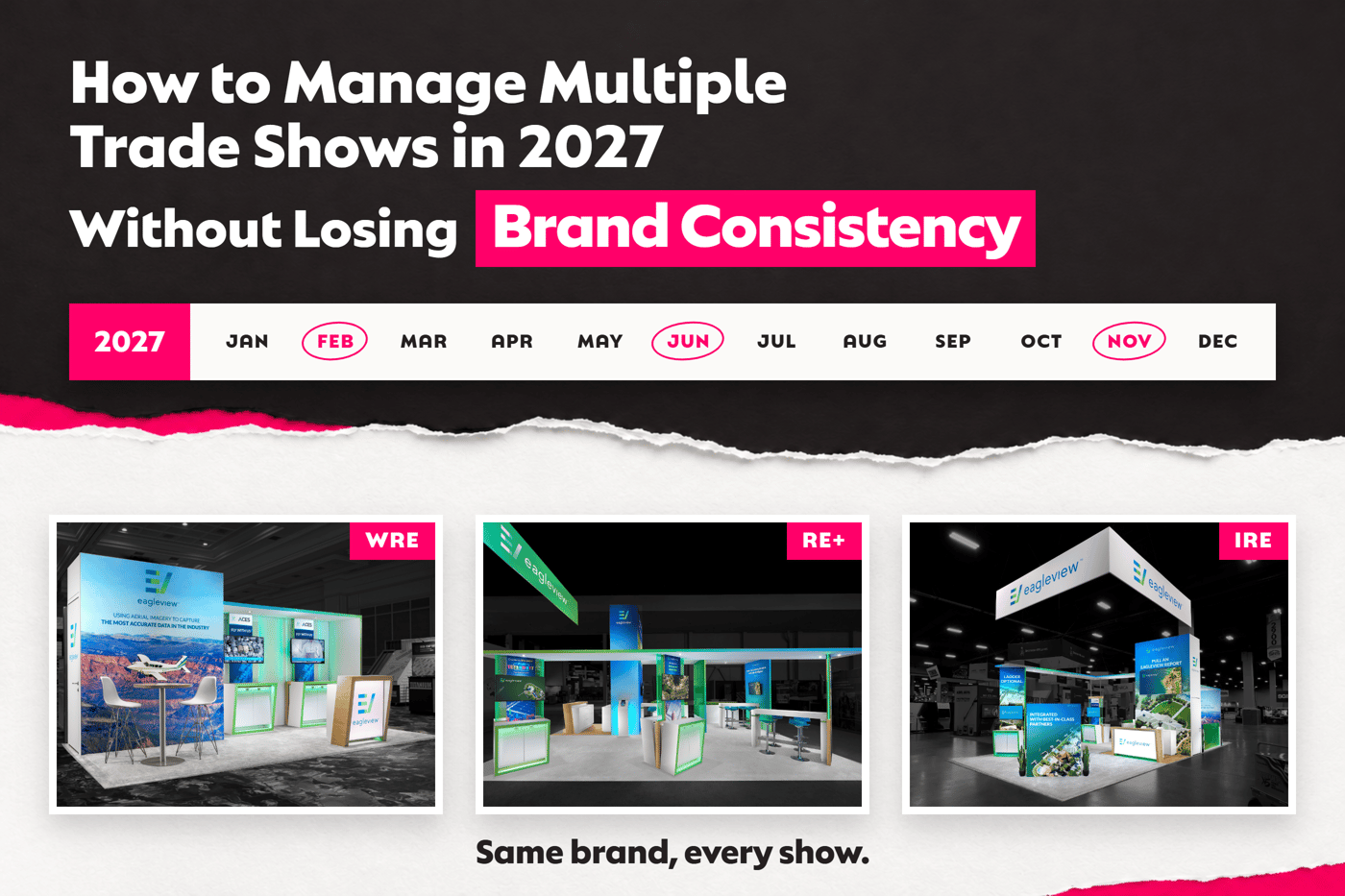
EagleView came to us needing a partner who could keep their brand consistent while adapting quickly to a wide range of events. Through our Access Model, it moved to a modular, rental-based program built on a single exhibit system that flexes across booth sizes, layouts, and event types. For more on how flexible systems keep a brand recognizable as booth sizes change, see our guide to designing flexible exhibits for multi-show use.
How Does a Full-Service Exhibit Partner Keep Every Show On-Brand?
A full-service partner keeps your program consistent by running every show through the same process, with the same team and standards behind each one. At Exhibit Happy by Steelhead, here's how that works from planning through the show floor:
- Plan the full program. During the First 15, your Client Services team aligns stakeholders, defines scope, and sets timelines and milestones.
- Design each show from your standards. Our Proven Design Process starts with your show strategy, tactical requirements, and confirmed budget, so each design is built around your goals for that show.
- Check graphics before they ship. Our Project Management team uses structured reviews to confirm that graphics and production elements are accurate, approved, and ready before they leave our facility, so what reaches the show floor matches what you signed off on.
- See it built before the show. Full pre-staging lets you walk through your exhibit before it ships and review fit, finish, and sightlines while changes are still simple.
- Show up ready. Our on-site supervisors coordinate installation and dismantle and have the booth ready before your team arrives each morning.
- Learn and reset after each show. A post-show review captures what worked for the next event, and rental elements come back to our facility to be inspected and made show ready, so the fit and finish holds up from one show to the next.
With that structure in place, keeping every show on-brand doesn't add to your team's workload. As Sean puts it, "People on our side of the fence should not be here to create any more work for the event manager." Our guide to what a full-service exhibit program should include breaks down which responsibilities a partner should take on and which stay with your team.
Planning a full 2027 show calendar? Let's map it out together, so every show looks and feels like your brand.
What Should You Ask an Exhibit Partner About a Multi-Show Program?
Ask questions that show whether a partner can manage your full calendar as one program while keeping your brand consistent at every show. These five cover the essentials:
- Will we have a dedicated program manager who knows our brand and goals? One point of contact across your calendar keeps decisions, deadlines, and brand standards in the same hands.
- How will you tailor our brand for different audiences and booth sizes? Look for a partner that adapts the experience to each show without losing what makes your brand recognizable.
- Can we see our exhibit fully built before it ships? Not every partner includes pre-staging, so ask whether you can review fit, finish, and graphics before the show.
- Do you guarantee your pricing, and how are scope changes approved? Clear pricing and an approval process keep a growing calendar from bringing budget surprises.
- How do you handle storage and logistics between shows? A partner managing your program should be able to explain how every element is stored, checked, and shipped so it arrives show ready.
At Exhibit Happy by Steelhead, our answer to whether we handle multi-show and multi-city programs is yes: from booth storage logistics to consistency and brand experience, we manage multi-event programs.
Where Exhibit Happy by Steelhead Comes In
A full calendar asks a lot of your team, and the more shows you add, the more it helps to have one partner keeping your brand steady from show to show. At Exhibit Happy by Steelhead, we start with your whole calendar, design every exhibit around the same brand standards through our custom rental Access Model, and let you walk through your exhibit before it ships. Our Price Guarantee locks the price of the services we provide within your approved scope, so a growing calendar doesn't bring budget surprises.
Bring your show calendar, even if half of it is still in pencil. We'll help you plan a program that looks and feels like your brand at every stop. Book a Consultation to get started.
Frequently Asked Questions
How do you maintain brand consistency across multiple trade shows?
Plan your shows as one program, set the brand standards that stay the same at every show, and work with one full-service exhibit partner that designs each exhibit around them. Booth size, layout, and message emphasis can change with each audience, while your logo, colors, core message, and fit and finish stay consistent.
How many trade shows does the average B2B exhibitor do each year?
For the largest share of B2B exhibitors, the median is six exhibitions a year, according to CEIR's Marketing Spend Decision Report, a late-2025 survey of 362 exhibitors. In the same survey, 28 percent planned to add shows to their program.
Is a rental exhibit as on-brand as an owned exhibit?
It should be. Renting only means you don't own the exhibit. Our custom rentals are modular, flexible, and designed from your brand outward, and because each exhibit isn't tied to one owned structure, it can fit each footprint without being cut down or reworked.
Related Posts
- What a Full-Service Exhibit Program Should Include
- How Far in Advance Should You Plan a Custom Trade Show Exhibit?
- Designing Flexible Exhibits for Multi-Show Use
Sources:
- R. B. Zajonc, "Attitudinal Effects of Mere Exposure," Journal of Personality and Social Psychology Monograph Supplement, Vol. 9, No. 2, Part 2 (1968)
- Michelle Russell, "Research: Trade Shows Remain Top Marketing Investment," PCMA Convene, June 12, 2026 (CEIR Marketing Spend Decision Report)
- Inside Exhibit Happy: Program Management (Sean Combs)
- Inside Exhibit Happy: Exhibit Rentals and Turnkey Service (Sean Combs)
- Inside Exhibit Happy: Strategy Led Design (Sean Combs)
- Inside Exhibit Happy interview with Rhiannon Andersen and Omar Jimenez (upcoming episode, not yet released)
- Rhiannon Andersen, Why Your 2026 Events Must Think Beyond Marketing
- Exhibit Happy by Steelhead, EagleView case study
- Exhibit Happy by Steelhead, Trade Show Booth Design FAQs
- The Science of Event Marketing: Mastering Event Marketing Psychology With the Laws of Attraction
- The Science of Event Marketing: Cognitive Secrets for Trade Show Marketers
- Exhibit Happy by Steelhead, Trade Show Program Process
- Exhibit Happy by Steelhead, How Far in Advance Should You Plan a Custom Trade Show Exhibit?
- Exhibit Happy by Steelhead, What a Full-Service Exhibit Program Should Include