


Published November 10, 2026
More shows on the calendar. More reasons to own a trade show booth, right? At Exhibit Happy by Steelhead, we see it differently. We recommend custom booth rentals for every exhibit program, and a busy show calendar makes that flexibility even more valuable.
Buying can look simple when you picture the same booth at every show. But what happens when your next event needs a smaller footprint, a different experience, or a booth across the country while another show is still underway? The question becomes less about how often you can reuse one booth and more about what your team needs to accomplish at each event.
That's what our Access Model is built for. Each exhibit is designed around your brand, goals, and budget, with room to adapt as your program grows. You get a custom presence at every show without owning, storing, or maintaining anything between events.
In this article:
- Where the three-use rule falls short
- What changes across multiple shows
- What owning really costs between events
- The one case where owning makes sense
The Quick Answer
- Renting wins on a multi-show calendar. Each show gets the booth it needs, with nothing to buy, store, or maintain between events.
- The three-use rule assumes nothing changes. It counts uses of one configuration, but it doesn't account for how much your program can change over a booth's three to five years of use.
- Multiple shows break the one-booth plan. Footprints change, dates overlap, and messages move faster than an owned booth can.
- Owning only replaces the structure. Graphics, install, and freight still hit every show's bill, and storage and refurbishment get added on top.
- Owning fits one narrow case. Portable displays used again and again in the same footprint.
How Many Shows Does It Take for Buying a Booth to Pay Off?
The common rule of thumb is to buy once you'll use the same booth configuration more than three times. On paper, that can make a busy calendar look like a reason to buy.
The catch is "the same configuration." A busy calendar can look like plenty of uses until you sort it by booth size. One that mixes inlines, islands, and peninsulas rarely puts any one booth over that line.
Time matters, too. An owned booth typically gets three to five years of use, and your marketing will change long before it wears out. Your goals shift, your audiences grow, and your brand gets refreshed, so your booth should keep up. We never want your booth to decide your marketing strategy. It should be the other way around.
That's why we don't think anyone should be tethered to an outdated structure. As our CMO, Rhiannon Andersen, asks in The Sunk Cost Trap, "Is your current 'ownership' model serving your strategy, or is your strategy being forced to serve your warehouse inventory?"
What Changes When You Exhibit at Multiple Shows?
Three things tend to break the "one booth, many shows" plan: footprints that change, shows that fall back to back, and messages that move faster than the booth. More programs are running into that, too. In a late-2025 CEIR survey reported by TSNN, 28% of exhibitors said they expect to add more shows. Our CEO, Sean Combs, made the same point on Inside Exhibit Happy when asked about renting versus owning. Each show can bring a different city, footprint, spot on the floor, and audience, along with changes in your business and brand.
Your Footprint Changes From Show to Show
Most multi-show programs don't exhibit in the same size space at every event. You might have a 20x20 at regional shows and a 50x50 island at your flagship, and one owned booth can't be both. Owning one size still leaves you renting or building for the rest.
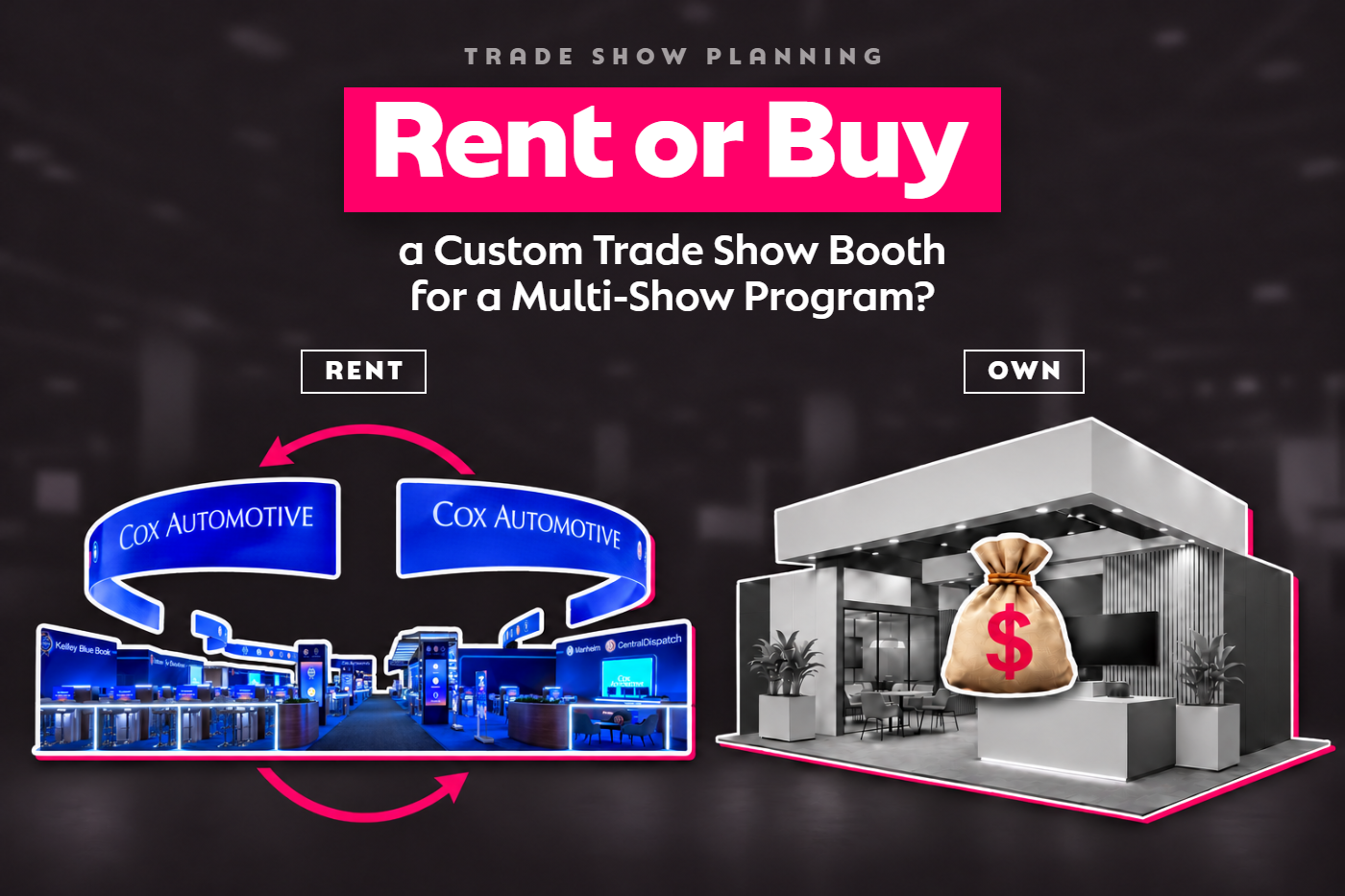
That range is exactly what we plan for. Cox Automotive runs its program across multiple events and brands, and through our Access Model, the team can adjust booth size, layout, and brand emphasis for each show while keeping a cohesive, premium look. You can also budget each show for what it actually needs, instead of stretching one booth to cover your whole calendar.
Your Shows Can Fall Back to Back
An owned booth can only be in one place at a time. Back-to-back dates leave little time to ship it, fix anything that took a hit, and get it show-ready again, which is why concurrent shows are one of the first things to weigh in a rent-or-buy decision.
When you rent from us, that timing is our job. We plan your whole program, decide which elements go where, and draw from our inventory or build new for each show. When pieces come back, our team inspects and repairs them at our cost, so you're never scrambling a week out.
Your Message Changes Before the Booth Wears Out
A traditional build locks you into a design made months in advance, sometimes up to a year, because it has to work the same way at every show. On Inside Exhibit Happy, Adam Forbes, our Business Systems Manager, explains that with our Access Model, each show can look entirely different, whether it's a month or a year after the last one. No one wants to see last year's design twice.
Keeping your brand consistent doesn't require owning the booth. Your logo, colors, and voice stay the same from show to show, and the experience around them is what changes.
HD Supply is a good example. Its case study notes that owning a single exhibit would have forced repetition across its many shows and audiences. Because the program is rental only, the team gets custom exhibits for each event, and when HD Supply was acquired by The Home Depot, we designed new exhibit environments around the updated brand.
Planning a 2027 calendar with more than one booth size? Let's map out what each show needs, so your team can see the full picture before you commit.
What Does It Cost to Own a Booth Between Shows?
Owning a booth comes with costs that keep running long after the show closes:
- Storage between shows
- Warehouse handling and prep before every show
- Insurance
- Maintenance and repairs
- Refurbishment to keep an aging booth looking current
- Disposal once the booth is retired
If your calendar needs more than one booth size, owning means owning more than one booth, and each of these costs comes with every one of them.
Storage keeps getting more expensive. These ongoing expenses aren't getting any cheaper. Producer prices for general warehousing and storage rose about 4.4% from September 2025 to September 2026 and about 11% over three years, according to the U.S. Bureau of Labor Statistics.
There's little to recover at the end. Disposal is the cost many teams forget to budget for, and exhibit houses that buy back old properties often offer only about 10 cents on the dollar.
Owning doesn't remove the per-show bill. Buying a booth replaces the structure, but these still show up at every show:
- Graphics
- Install and dismantle
- Flooring, AV, and furniture
- Freight
- Design and project management
Ownership changes one line of your budget and adds the ongoing costs above on top of it.
Someone still has to keep it moving. Shipping, install and dismantle, and on-site support have to be coordinated for every show, either by your team or by a partner you pay. With Exhibit Happy by Steelhead, that's all part of the service. Our Price Guarantee locks the price of Steelhead-provided services, from design and production through transportation, installation, and on-site support. Because we own the exhibit, you aren't on the hook for wear and tear, and ownership costs are absorbed into the rental fee.
When Does Owning a Booth Make Sense?
We believe there's one case where owning makes sense: a portable program that uses the same displays in the same footprint, show after show. On Inside Exhibit Happy, Sean explains that he'd own those pieces, since they're high-volume items that get nicked and replaced over their life cycle. It's the one situation the three-use rule actually fits.
Outside of that, we recommend renting. Sean's point is simple: using an exhibit because the company already bought it isn't strategic marketing. If you already own portable displays that fit part of your calendar, keep using them where they work, and rent the custom environments your larger or changing shows need.
How Do You Compare Renting and Owning for Your Own Program?
Start with your full show calendar, then compare the total cost of renting and owning across the same events. Factor in booth sizes, timing, and how much your marketing needs could change. A lower price today only tells you so much about whether a booth will work for your program three years from now.
Here are five steps to work through:
- Map your shows and what each needs to accomplish. List dates, booth sizes, audiences, and goals. Flag overlapping or back-to-back events that could make moving one booth between shows difficult.
- Count how often you'd use each setup. Six shows don't necessarily mean six uses of the same booth. Group events by size and layout to see where one configuration could work and where you'd need something different.
- Build the full ownership estimate. Include the purchase price, storage, warehouse handling, insurance, transportation, maintenance, updates, and eventual disposal, plus any supplemental rentals you'd need for different footprints or overlapping shows.
- Compare rental pricing for the same scope. Confirm what each proposal includes, what costs extra, and whether the price is guaranteed in writing. Booth space and general contractor services apply either way, so include them on both sides.
- Leave room for your marketing to change. Think about product launches, new audiences, and brand updates over the next few years. What would it take to adapt an owned booth, and how would that compare with renting?
Bring your exhibit partner into that conversation early. Omar Jimenez, one of our account directors, recommends sharing every show you're considering and whether you'll be reaching the same audience or a different one at each event. That gives you a chance to discuss what can be reused and where design decisions could help control costs.
You don't need a finalized calendar to get started. A draft show list and likely booth sizes are enough to begin planning.
Is Renting a Booth More Sustainable Than Owning One?
Renting can support a lower-waste exhibit program by keeping booth components in use across shows and brands. With our Access Model, on average, over 90% of an exhibit returns to Steelhead to be repurposed and reimagined for other clients in other industries throughout the year. Those components become part of another brand's experience instead of sitting in storage until one company's next show.
When a component reaches the end of its useful life, we look for opportunities to donate or repurpose it before considering landfill disposal.
As a Certified B Corporation, we also share our measured results in our annual ESG reporting.
Where Exhibit Happy by Steelhead Comes In
A busy show calendar shouldn't lock you into one booth. With our Access Model, each event gets the footprint and experience it needs, and your dedicated program manager keeps timelines, shipping, and on-site services moving across every show.
Before anything ships, we pre-stage your exhibit so you can walk through it fully built. Our Price Guarantee locks the price of Steelhead-provided services unless you approve a change in scope.
Bring us your show list, even if it's still a draft, and book a consultation to see what a program built around your goals could look like. Your marketing should never be defined by the booth you bought for last year's plan.
Frequently Asked Questions
Is it better to rent or buy a custom trade show booth for multiple shows?
We recommend renting. When footprints, show dates, or messages vary, custom rental gives each show the booth it needs without buying, storing, and maintaining several structures. Owning only makes sense for portable displays used again and again in the same footprint.
How many times do you need to use a trade show booth before buying it pays off?
The common rule of thumb is more than three uses of the same configuration. We'd add a caution: that math assumes your needs stay the same over the three to five years of use a booth typically gets. Count uses per configuration and include every ownership cost.
Is renting a trade show booth cheaper than buying one?
Not always on a per-show basis. Over enough uses, an owned booth can look cheaper on paper, but that assumes the same configuration and the same marketing needs at every show. Graphics, install and dismantle, and freight also stay on every show's bill either way.
What does it cost to own a trade show booth between shows?
Ongoing costs include storage, warehouse handling, insurance, maintenance and repairs, refurbishment, and eventual disposal. When you rent from us, those costs are absorbed into the rental fee because we own and maintain the components.
Is renting a trade show booth more sustainable than buying one?
It can be, because rental components are reused across shows and brands instead of being built for a single program. Ask any partner how it reuses materials and whether it reports measured results. As a Certified B Corporation, we share ours in our annual ESG reporting.
Related Posts
- How to Manage Multiple Trade Shows in 2027 Without Losing Brand Consistency
- How to Budget for Trade Show Booth Costs in 2027
- 7 Things to Know About Reusable Booth Rentals
Sources:
- Candy Adams, CTSM, "Rent Check," EXHIBITOR magazine
- Betsy Earle, CTSM, "Rent Right," EXHIBITOR magazine
- Ben Barclay, "Rental Rookies: A Primer," EXHIBITOR magazine
- Linda Armstrong, "Expired?," EXHIBITOR magazine
- Linda Armstrong, "Where Do Broken Booths Go?," EXHIBITOR magazine
- U.S. Bureau of Labor Statistics, Producer Price Index by Industry: General Warehousing and Storage (PCU493110493110), via FRED
- Nancy Drapeau, CEIR, "Where Exhibitors Spend Their Budget, and What It Reveals About B2B Marketing Today," TSNN (April 21, 2026)
- Rhiannon Andersen, The Sunk Cost Trap: Why Smart Brands Are Moving Away from Exhibit Ownership
- Exhibit Happy by Steelhead, Custom, But Rental: Trade Show Booths You Never Have to Own (video)
- Inside Exhibit Happy: Exhibit Value and Investment (Sean Combs)
- Inside Exhibit Happy: The Business of Better Exhibiting (Adam Forbes), July 14, 2026
- Inside Exhibit Happy, unreleased interview with Omar Jimenez, account director
- Exhibit Happy by Steelhead case studies: Cox Automotive, HD Supply
- Exhibit Happy by Steelhead, Exhibit Management and Price Guarantee
- B Lab, Steelhead Productions B Corp directory listing
- Steelhead Productions, 2025 ESG Report