


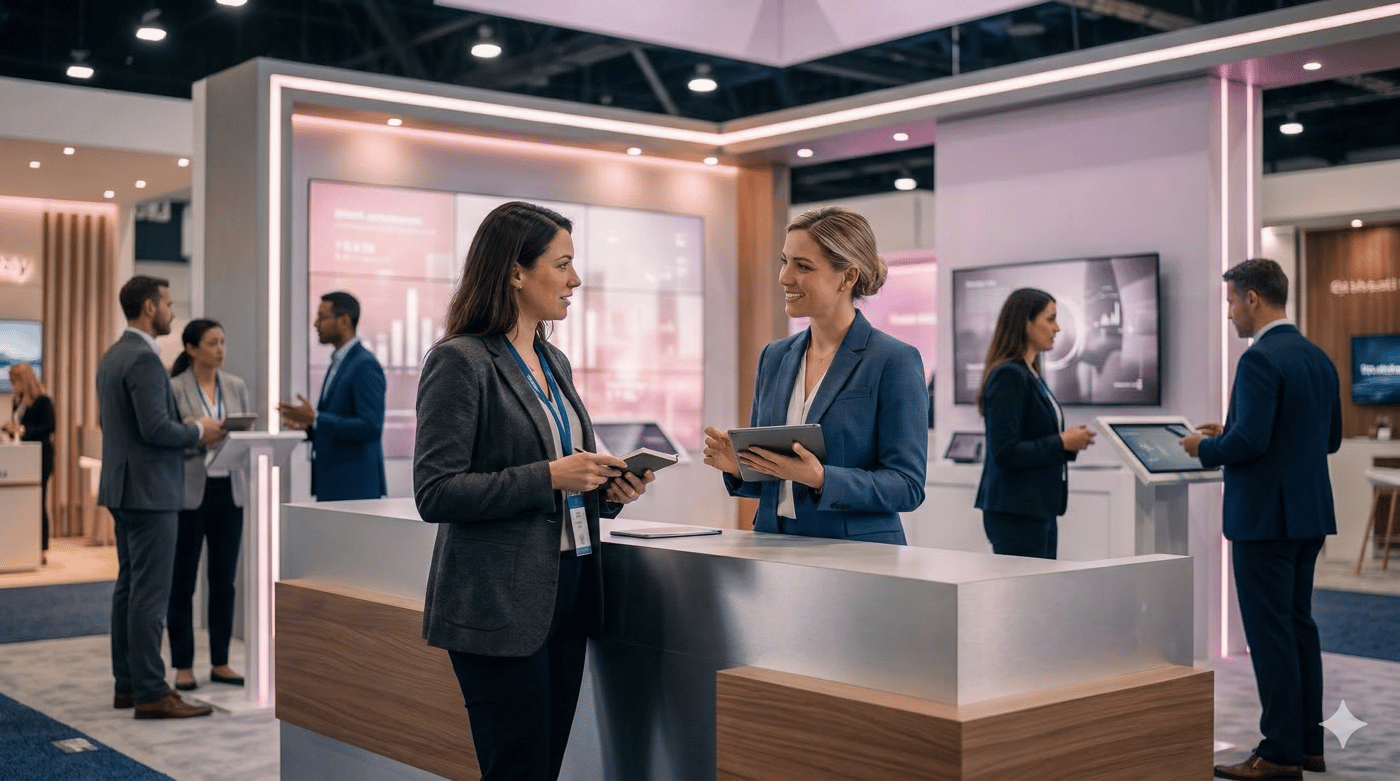
Technology is no longer optional on the trade show floor—it’s expected. According to the Center for Exhibition Industry Research (CEIR), 81% of trade show attendees have buying authority, meaning the people walking into your booth are often decision-makers or strong influencers in the purchase process. When high-value prospects are evaluating your brand in real time, the technology you use inside your exhibit environment matters.
But here’s the catch: more tech doesn’t automatically mean better results.
Technology-enabled trade show booths can elevate engagement, simplify lead capture, and support measurable ROI. Or they can create confusion, technical failures, and wasted budget.
For event managers planning their next program, the real question isn’t whether to integrate technology—it’s which technologies enhance the experience and which distract from it.
What Makes a Booth “Technology-Enabled”?
Technology-enabled trade show booths strategically integrate digital tools to improve:
-
Engagement
-
Lead capture
-
Data collection
-
Personalization
-
Operational efficiency
This includes everything from LED walls and touchscreens to RFID badge scanning and immersive AR/VR environments.
However, technology should support your exhibit strategy—not dominate it. If you’re planning your overall exhibit approach, explore how digital planning integrates into a broader experience-driven trade show strategy to ensure alignment from concept to execution.
What to Use: Smart Technologies That Enhance Experience
1. Interactive Touchscreens (When Used With Purpose)
-
Touchscreens can be powerful when they:
-
Replace printed collateral
-
Allow visitors to self-navigate content
-
Personalize information by role or industry
For example, an interactive product selector tailored to vertical markets adds value. A looping corporate video with no clear call-to-action does not.
Touchscreens should always:
-
Include a lead capture moment
-
Offer a takeaway (email summary, downloadable asset, or QR code)
-
Support booth staff conversations
If your screen doesn’t drive action, it’s just expensive wallpaper.
2. Seamless Lead Capture Technology
Lead capture is one of the most important components of technology-enabled trade show booths.
Smart integrations include:
-
CRM-synced badge scanners
-
Qualification fields for sales readiness
-
Automated post-show email triggers
-
Real-time scoring dashboards
Technology that reduces manual data entry saves hours post-show and increases follow-up speed—which is critical for pipeline acceleration.
If you’re evaluating exhibit partners, this is part of a larger performance conversation. Consider reviewing trade show performance metrics that actually matter to ensure your technology supports measurable outcomes.
3. LED Walls and Dynamic Digital Displays
LED walls can elevate your brand presence dramatically—but only when they serve a clear purpose.
Use them to:
-
Showcase dynamic product visuals
-
Highlight customer testimonials
-
Display social proof or live metrics
-
Create immersive brand environments
Skip them if:
-
They’re purely decorative
-
Your content isn’t optimized for scale
-
Your booth footprint doesn’t support sightlines
Large-format digital displays should enhance storytelling, not overwhelm it. This is especially important in innovative trade show booth design where visual hierarchy matters more than sheer size.
4. Augmented Reality (AR) and Virtual Reality (VR)
AR and VR are powerful in specific scenarios:
-
Complex product demonstrations
-
Heavy machinery that can’t be transported
-
Immersive training simulations
-
Architectural or environmental walkthroughs
However, these tools should solve a physical limitation or create an impossible-to-replicate experience.
If attendees need lengthy instructions or feel isolated from the rest of the booth experience, engagement drops. Always design VR with:
-
Clear queue management
-
Staff facilitation
-
A follow-up conversion mechanism
Otherwise, it becomes a novelty rather than a sales tool.
5. RFID & Behavioral Tracking (With Transparency)
Smart badges and RFID tracking can provide:
-
Dwell time insights
-
Content engagement data
-
Traffic heat mapping
This data can dramatically improve future exhibit planning.
However, transparency matters. Attendees should understand what’s being tracked and why. Clear signage and opt-in engagement build trust and align with broader brand governance practices.
How Scalable Exhibit Design Solutions Support Multi-Event Growth
Let’s look at what scalability enables at a strategic level.
Consistent Brand Presence Across Markets
Whether your team is in Chicago, Las Vegas, or Orlando, your exhibit should deliver a unified brand experience.
A scalable system ensures:
-
Visual consistency
-
Structural continuity
-
Standardized experiential elements
Your booth becomes recognizable — even when resized.
Faster Turnaround Between Shows
When your exhibit system is designed to flex, show prep becomes more efficient.
Instead of redesigning, you:
-
Reconfigure.
-
Update graphics.
-
Adjust layout.
This is especially important for companies adding shows mid-year or responding to competitive shifts.
Scalability reduces chaos.
Marketing, operations, sales, and executive leadership operate from the same blueprint. Expectations are clear. Capabilities are defined. Performance becomes measurable.
For a Director of Marketing, this creates executive confidence.
What to Skip: Technology That Distracts
1. Gimmicky Motion Sensors and Unrelated Gamification
Not all gamification is bad—but it must align with your messaging.
Skip:
-
Random prize wheels unrelated to your product
-
Arcade games with no brand tie-in
-
Tech activations that attract crowds but not qualified leads
If the interaction doesn’t move prospects further down the funnel, it’s noise.
Instead, build engagement that supports a broader experiential trade show marketing strategy where interaction drives business outcomes.
2. Overcomplicated Digital Installations
If your tech requires:
-
On-site IT support all day
-
Complex troubleshooting
-
Excessive wiring or structural modification
…it increases risk.
Event managers already juggle logistics, timelines, and stakeholders. Technology should simplify operations—not create stress.
When planning digital integration, align it with a broader digital integration in exhibit design strategy to ensure infrastructure and design work together.
3. Excessive Screens With No Human Connection
One of the biggest mistakes in technology-enabled trade show booths is replacing people with screens.
Remember:
Trade shows are face-to-face marketing environments.
Technology should:
-
Start conversations
-
Support storytelling
-
Capture insights
It should never eliminate the human element that drives trust and relationship-building.
How to Evaluate Technology Before You Commit
Before adding any digital component, ask:
-
Does this technology solve a problem?
-
Does it increase engagement quality or just volume?
-
Does it simplify lead capture and follow-up?
-
Is it scalable across multiple shows?
-
Does it align with our overall exhibit strategy?
If the answer to most of these is “no,” reconsider.
For growing brands, it’s especially important to think long-term. Scalable systems—both structural and digital—support consistency across multiple events. Explore how scalable exhibit design solutions can integrate technology without reinventing the booth every time.
The Balance: Technology + Strategy + Design
The most effective technology-enabled trade show booths integrate:
-
Strategic intent
-
Operational simplicity
-
Immersive design
-
Measurable performance
Technology is a tool—not the strategy itself.
When integrated correctly, it can:
-
Increase dwell time
-
Improve lead quality
-
Accelerate sales conversations
-
Deliver measurable ROI
When integrated poorly, it becomes a distraction that drains resources.
Smart Tech Wins
Technology-enabled trade show booths work best when they enhance the experience—not compete with it.
Use technology to:
-
Clarify your message
-
Capture better data
-
Support human interaction
-
Improve post-show follow-up
Skip technology that:
-
Adds complexity
-
Creates noise
-
Lacks strategic purpose
As an event manager, your role isn’t to chase trends. It’s to build exhibit environments that support brand growth, pipeline development, and long-term scalability.
If you’re evaluating how to integrate smart technology into your next exhibit without overcomplicating your program, it starts with strategy—not gadgets.
Ready to Build a Smarter Exhibit?
If you’re planning your next program and want guidance on integrating technology the right way, contact us.
Our team specializes in designing technology-enabled trade show booths that balance innovation, simplicity, and measurable impact—so you can show up smarter at every event.