


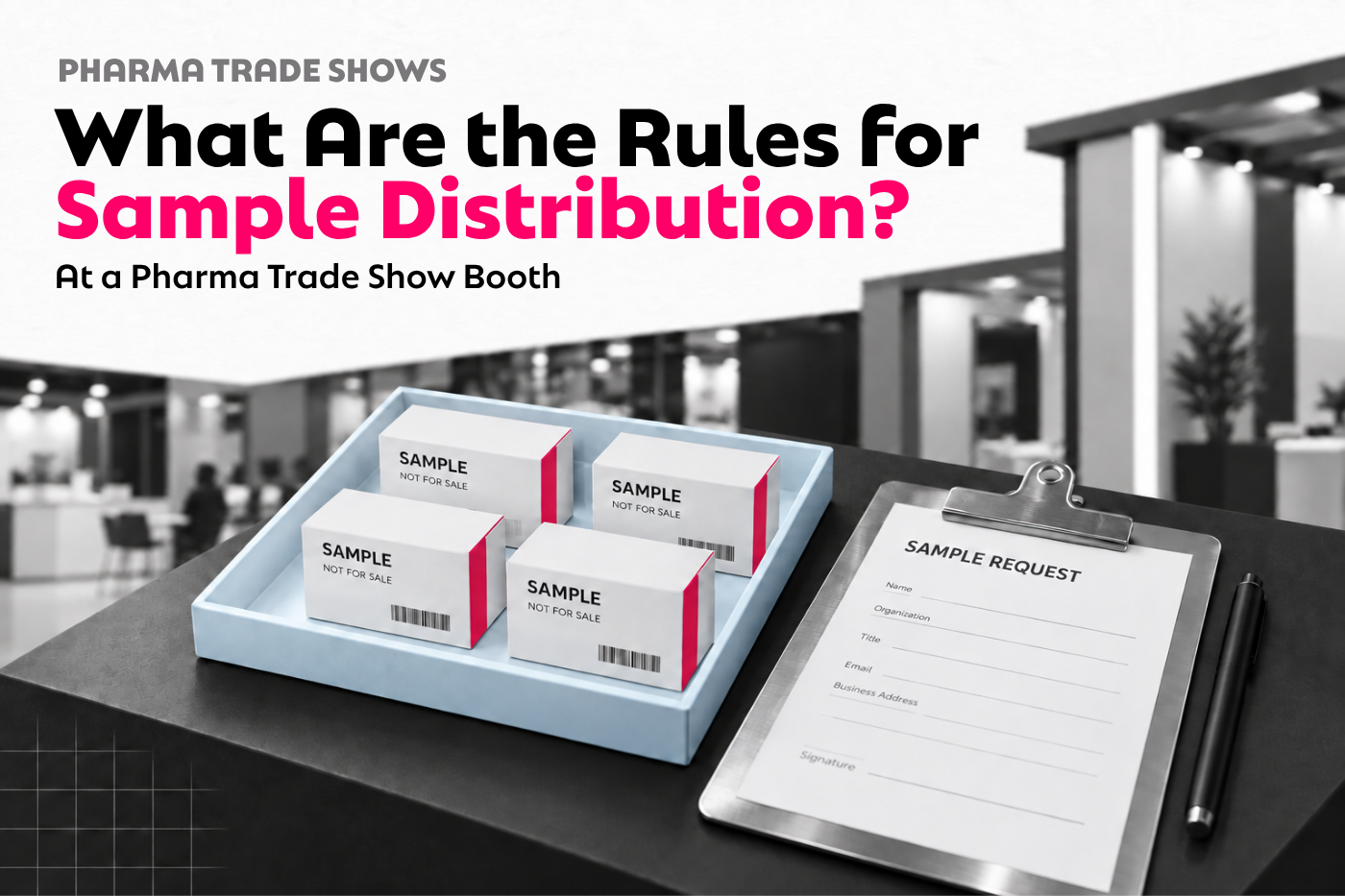
A patient education brochure and a prescription drug sample can cross the same booth counter, but federal law treats them nothing alike.
The Prescription Drug Marketing Act (PDMA) and its rules at 21 CFR Part 203 control who may receive a prescription drug sample and what has to be signed before it moves.
None of that pauses because you are standing on a trade show floor.
Speak with our healthcare team if samples, demos, or product handouts are part of your booth plan and you want the requirements designed in before the floor opens.
The Quick Answer
Prescription drug samples may be distributed at a booth, and PDMA requirements do not relax because the setting is a trade show.
- Samples may be distributed to a practitioner authorized to prescribe that drug, or to a hospital or health care entity pharmacy at that practitioner’s written request, under 21 CFR 203.31.
- Before delivery, the manufacturer or authorized distributor of record must receive the practitioner’s signed written request and verify their authority to prescribe that drug with the appropriate state authority, under 21 CFR 203.31.
- The recipient signs a receipt at delivery that identifies who received the samples and records the drug, strength, quantity, and delivery date, under 21 CFR 203.31(c).
- Open-ended or standing requests are prohibited. A written request for a specified quantity delivered over no more than six months is permitted under 21 CFR 203.35.
- Requests and receipts must be kept for at least three years from the date they are created, under 21 CFR 203.60.
Quick Note: Whether federal law permits a sample is separate from whether the show allows it and whether your compliance team approved it. You need all three.
This article provides general information, not legal or compliance advice. Requirements and penalty amounts change over time, and sampling decisions depend on the product, the recipient, and the jurisdiction. Confirm your company's obligations with its legal and compliance teams before setting booth policy.
On this page
- The Quick Answer
- What Counts as a Drug Sample?
- Who Can Legally Receive a Sample at Your Booth?
- The Paperwork Happens Before the Sample Moves
- What the Storage Rule Requires, and What It Leaves to You
- What Reporting Requirements Apply to Drug Samples?
- Does Your Booth Team Need a License?
- Show Rules Sit on Top of the Federal Ones
- What’s Prohibited, and What Are the Penalties?
- Put Your Sampling Plan Into Practice
- Where Exhibit Happy by Steelhead Comes In
What Counts as a Drug Sample?
A drug sample is a unit of a prescription drug that is not intended to be sold and is intended to promote the sale of that drug, under 21 CFR 203.3(i).
Over-the-counter products and devices fall outside this prescription drug-sample definition, but they have their own requirements. Selling a prescription drug sample is prohibited under 21 USC 353(c)(1).
That distinction matters because handouts are governed by different rules depending on what they are. Patient education materials, journal reprints, and device demo units each have their own requirements. A prescription drug sample brings requirements your team needs to address before it reaches the booth counter.
Under 21 CFR 203.38, an identifying lot or control number must appear on each sample unit’s label and any outside container or packaging. The sample label must also clearly identify its status, with wording such as “sample,” “not for sale,” or “professional courtesy package.”
The manufacturer or authorized distributor of record must maintain distribution records that allow samples to be tracked by lot or control number to the practitioner who received them.
Who Can Legally Receive a Sample at Your Booth?
Under 21 USC 353(d), a manufacturer or authorized distributor of record may distribute samples to a licensed practitioner or, at that practitioner’s written request, to a hospital or other health care entity pharmacy.
A licensed practitioner is someone licensed or authorized under state law to prescribe drugs, as defined in 21 CFR 203.3(r). For sampling, that authority must cover the specific drug being requested.
Here is the part that matters for your booth team: before delivery, the manufacturer or authorized distributor of record must verify that prescribing authority with the appropriate state authority under 21 CFR 203.31(a).
A badge scan is not verification.
At a national congress, attendees may hold licenses in different states, and some may have no prescribing authority at all. Your sampling process needs to account for that before a sample changes hands.
The Paperwork Happens Before the Sample Moves
The written request comes first.
Under 21 CFR 203.31(b), the request must include:
- The practitioner’s name, address, professional title, and signature.
- Their state license or authorization number, or their DEA number when requesting a controlled substance.
- The drug name, strength, and quantity requested.
- The manufacturer’s name and, if requested through an authorized distributor of record, that distributor’s name.
- The date of the request.
The receipt comes at delivery.
Under 203.31(c), it records the recipient's name, address, professional title, and signature, the name and strength of the sample, the quantity delivered, and the delivery date. Delivery to a hospital or health care entity pharmacy requires additional identifying details on both the request and receipt. Use the form approved for that delivery route.
A request cannot serve as open-ended permission to send more samples.
Under 21 CFR 203.35, manufacturers "shall not distribute drug samples on the basis of open-ended or standing requests, but shall require separate written requests for each drug sample or group of samples."
There is one narrow flex.
A practitioner may request a specified quantity delivered over a period not exceeding 6 months, with individual delivery dates arranged later. That is not treated as a standing request.
Forms can be electronic, under two separate conditions:
- 21 CFR 203.33 allows request and receipt forms to be transmitted photographically or electronically, provided the transmission method meets the security requirements at 203.60(c).
- Separately, 21 CFR 203.60(a) permits electronic records and electronic signatures to substitute for paper only where the requirements of 21 CFR Part 11 are met.
Capturing a signature on a tablet is only one step. The electronic records and signature process must meet the requirements of 21 CFR Part 11, as required by 21 CFR 203.60(a).
Then you keep them.
Section 203.60(d) requires sample distribution records to be retained at least 3 years after creation. Section 203.60(e) requires them produced to regulatory officials within 2 business days of a request.
Handing the work to a vendor does not hand off the obligation.
Under 21 CFR 203.36, a manufacturer or authorized distributor of record using a fulfillment house, shipping service, or other third party stays responsible for creating and maintaining every required request, receipt, form, report, and record.
What the Storage Rule Requires, and What It Leaves to You
Under 21 CFR 203.32, manufacturers, authorized distributors of record, and their representatives must store and handle samples in conditions that protect their stability, integrity, and effectiveness and keep them free of contamination, deterioration, and adulteration. Following the product’s applicable compendial standards and labeled storage and handling requirements will generally satisfy this rule.
21 CFR 203.34 requires manufacturers and authorized distributors of record to establish and follow written procedures covering:
- How representatives store samples.
- How requests and receipts are reconciled and patterns of missing receipts are addressed.
- How annual physical inventories and reconciliation reports are completed.
- How sample security is maintained, including random and for-cause audits by personnel independent of the sales force.
- How losses and thefts are monitored, significant losses are identified, and FDA is notified.
Those requirements need to translate into a workable booth plan. Our recommendation: plan lockable storage within your booth footprint, with enough capacity for the samples you bring and access limited to authorized staff. Work with your compliance team to confirm that the setup supports the product’s required storage and handling conditions.
Plan the space, equipment, and access before the booth design is finalized, so your team can follow the approved process even when the floor gets busy. For a broader look at the costs of storing your booth and demo equipment between shows, see Healthcare-Grade Exhibit Storage: What It Actually Costs You.
If Samples Go Missing, the Clock Starts
Under 21 CFR 203.37(b), once a manufacturer or authorized distributor of record becomes aware of a significant loss or known theft of drug samples, it must:
- Notify FDA by telephone or in writing within 5 working days.
- Immediately begin an investigation.
- Provide FDA a complete written report within 30 days of that first notification.
The rule does not set a numerical threshold for “significant loss.” Under 21 CFR 203.34, manufacturers and authorized distributors of record must have written procedures for identifying significant losses and notifying FDA. Make sure your booth team knows how to flag missing samples through that process.
Under 21 CFR 203.37(a), the same obligations apply when a manufacturer or authorized distributor of record has reason to believe someone has falsified sample requests, receipts, or records, or is diverting samples: notify FDA within 5 working days, begin investigating immediately, and submit a complete written report, including the reason for and results of the investigation, within 30 days of the initial notification.
What Reporting Requirements Apply to Drug Samples?
Qualifying patient-use samples are excluded from Open Payments, but separate reporting requirements still apply.
Under 42 CFR 403.904(h)(3), the exclusion covers product samples intended for patient use and not intended for sale, including coupons and vouchers patients can use to obtain samples.
That distinction matters at your booth. A qualifying drug sample receives different treatment from a giveaway, meal, or other item provided to a healthcare professional. We cover those interactions in What Counts as a Reportable HCP Interaction Under the Sunshine Act at a Trade Show Booth?.
Drug samples have their own federal reporting requirement.
Under 42 USC 1320a-7i, manufacturers and authorized distributors of record of applicable drugs must submit annual sample information covering the preceding calendar year. FDA administers this reporting program, known as ACA Section 6004 reporting.
The required information includes:
- The identity and quantity of samples requested
- The identity and quantity of samples distributed
- The name, address, professional designation, and signature of the practitioner making the request, or any individual making or signing for the request on the practitioner’s behalf
The annual submission is due no later than April 1. Your booth’s sample records need to support that reporting process.
State reporting requirements may also apply.
Before the show, have your compliance team confirm which state requirements apply to your sampling program and who is responsible for each filing. Build that into the sampling process early, so your team captures the information it needs while requests and distributions are happening.
Does Your Booth Team Need a License?
That depends on where the show takes place and what each staff member will do. Before assigning anyone to promote prescription drugs, have your compliance team confirm the applicable licensing or registration requirements, including any exemptions.
If your medical congress schedule brings your team to Chicago several times a year, count each representative’s total qualifying business days in the city.
Under Section 4-6-310 of Chicago’s Municipal Code, pharmaceutical representatives must obtain a license unless they conduct that business in the city for fewer than 15 days per calendar year.
That count includes qualifying activity beyond a single show. Other meetings and sales visits in Chicago may bring a representative to the licensing threshold, so review each person’s annual schedule when planning booth assignments.
In Nevada, check the manufacturer’s representative list.
Under NRS 439B.660, manufacturers must submit a list of their pharmaceutical sales representatives to the state and update it at least annually. Representatives must appear on a current list before conducting the prescription-drug marketing activities covered by the statute, including marketing to Nevada-licensed healthcare providers.
This section establishes a manufacturer-submitted listing requirement, rather than an individual pharmaceutical representative license.
Chicago and Nevada illustrate why staffing requirements belong in your pre-show planning. For each destination, confirm who will promote products, whether their activities trigger local requirements, and that any required licenses or registrations are in place before they begin.
Show Rules Sit on Top of the Federal Ones
Show organizers set their own requirements for sampling, giveaways, booth activities, and approvals. Your program needs to satisfy those requirements alongside applicable law, so review the current exhibitor manual before finalizing your sampling plan.
For example, the American College of Physicians’ 2026 exhibitor rules required sample distribution and product detailing to stay inside the assigned booth space. Activities could not extend into the aisle, and exhibitors had to leave room within the booth for visitors. Booth activities also required advance review, with unapproved activities prohibited on-site.
Those requirements affect how you design the space.
If your sampling process includes practitioner verification, signed requests, and receipts, plan room for staff to complete those steps and for attendees to wait within your footprint. Position the signing station and sample storage so the process works during busy periods.
Before committing to the layout, confirm what the organizer permits, which activities need approval, and when submissions are due. Share those requirements with your exhibit partner early, and build the approval deadlines into your production schedule.
What’s Prohibited, and What Are the Penalties?
Drug samples cannot be sold, purchased, or traded.
21 USC 353(c)(1) prohibits those transactions, including offers to sell, purchase, or trade a sample. Under 21 USC 333(b)(1)(B), knowingly violating that prohibition can carry up to 10 years in prison, a $250,000 fine, or both.
Investigational products have separate promotional restrictions.
Under 21 CFR 312.7, sponsors, investigators, and people acting on their behalf cannot commercially promote an investigational drug or represent it as safe or effective for the purposes under investigation. The rule preserves scientific exchange, including discussion of scientific findings.
For investigational devices, 21 CFR 812.7 prohibits promotion or test marketing before FDA approval for commercial distribution and prohibits representations that the device is safe or effective for the purposes being investigated.
Have your medical, legal, and regulatory teams approve how investigational products will be discussed or displayed before the show.
Companies can also face civil penalties.
Under 21 USC 333(b)(2), manufacturers and distributors that distribute samples through means other than mail or common carrier can face civil penalties when a representative is convicted of specified sample-sale or trading violations committed during their employment or association with the company. The statute includes exceptions related to reporting, investigations, and independent audit and security systems.
Section 333(b)(3) separately addresses failures to submit reports required by 21 USC 353(d)(3)(E). Those are distinct from the annual ACA sample-distribution reports discussed above. Adjusted civil penalty amounts appear in the HHS penalty table.
The practical takeaway is to give booth staff an approved sampling process, clear limits on product discussions, and a designated contact for questions. Both the company and the people acting on its behalf can face consequences when those boundaries are crossed.
Put Your Sampling Plan Into Practice
Turn the requirements above into a clear plan for each stage of the show, with a named person responsible for every handoff.
Before the Show
Confirm the products approved for sampling, required organizer approvals, and staff eligibility. Set up the practitioner-verification process, approved request and receipt forms, and storage appropriate for the products. Brief the team on the full process before opening day.
During the Show
Follow the approved verification and documentation process for every distribution. Keep samples secure, maintain required storage conditions, and keep attendee queues within the assigned space. Give staff a clear contact for missing inventory, incomplete records, or other issues that require immediate attention.
At Closeout
Account for remaining samples, reconcile distribution records, and resolve discrepancies through the company’s approved process. Confirm who will take custody of the samples and documentation, including responsibility for retention and reporting.
Plan these handoffs before the show so responsibility stays clear through shift changes, busy periods, and teardown.
Where Exhibit Happy by Steelhead Comes In
A sampling program needs space for every step, from product storage and practitioner verification to documentation and the final handoff. The layout should make that process manageable for your staff while leaving room for the conversations that bring people into your booth.
Exhibit Happy by Steelhead helps marketing teams translate program requirements into practical exhibit environments. For sampling, that means planning storage, signing stations, and traffic flow around the process your legal and compliance teams approve.
Bring that process into the first design conversation, so the layout supports how your staff will actually work throughout the show.
Book a Consultation to discuss how your next exhibit can support your sampling program.
Frequently Asked Questions
Can you legally hand out drug samples at a trade show booth?
Yes, provided the program meets applicable federal, state, local, and organizer requirements. For direct delivery to a practitioner, the manufacturer or authorized distributor of record must receive a signed written request before delivery, verify prescribing authority with the appropriate state authority, and obtain a signed receipt at delivery. These requirements appear in 21 CFR 203.31.
Do you need a written request for every sample, or can one cover the whole show?
A request can cover a specified group of samples, but it cannot provide open-ended permission for additional distributions. 21 CFR 203.35 also permits a practitioner to request a specified quantity in writing for delivery over no more than six months, with individual delivery dates arranged later.
Are drug samples reportable under the Sunshine Act?
Qualifying samples intended for patient use and not for sale are excluded from Open Payments under 42 CFR 403.904(h)(3). Manufacturers and authorized distributors of record of applicable drugs have a separate annual federal sample-reporting obligation under 42 USC 1320a-7i, with submissions due no later than April 1 for the preceding calendar year.
How long do you have to keep booth sample records?
At least three years after creation. Under 21 CFR 203.60(d)–(e), required records must also be available to authorized regulatory or law enforcement officials within two business days of a request. Assign responsibility for storing and retrieving them before teardown.
Can a contractor or fulfillment vendor handle sample paperwork for you?
Yes. However, the manufacturer or authorized distributor of record remains responsible for creating and maintaining all required requests, receipts, forms, reports, and records, even when a third party handles the work. 21 CFR 203.36 establishes that responsibility.
Do booth staff need a license to promote pharmaceuticals at a show?
Requirements depend on the jurisdiction and the person’s activities. Chicago’s ordinance exempts pharmaceutical representatives conducting that business in the city for fewer than 15 days per calendar year. Nevada requires representatives to appear on a current manufacturer-submitted list before conducting the marketing activities covered by its statute. Have compliance confirm applicable requirements before assigning staff.
Sources:
- 21 USC 353, Cornell LII: prohibitions on selling, purchasing, or trading drug samples and requirements governing distribution to licensed practitioners and hospital or health care entity pharmacies.
- 21 USC 333(b), Cornell LII: criminal and civil penalties for specified drug-sample violations, including penalties for failure to submit reports required by 21 USC 353(d)(3)(E).
- 45 CFR 102.3, eCFR: HHS inflation-adjusted civil monetary penalties.
- 21 CFR 203.3, Cornell LII: definitions of “drug sample” and “licensed practitioner.”
- 21 CFR 203.31, Cornell LII: requirements for practitioner verification, written requests, delivery receipts, annual inventories and reconciliation, and representative and storage-location lists.
- 21 CFR 203.32, Cornell LII: drug-sample storage and handling requirements, including applicable compendial and labeling standards.
- 21 CFR 203.33, Cornell LII: photographic and electronic transmission of request and receipt forms, subject to the security requirements of 21 CFR 203.60(c).
- 21 CFR 203.34, Cornell LII: required written policies and procedures for sample storage, reconciliation, inventories, security, independent audits, and loss and theft reporting.
- 21 CFR 203.35, Cornell LII: prohibition on open-ended and standing requests and the exception for a specified quantity delivered over no more than six months.
- 21 CFR 203.36, Cornell LII: manufacturer and authorized distributor of record responsibility for required records when using fulfillment houses or other third parties.
- 21 CFR 203.37, Cornell LII: notification, investigation, and written-report requirements for suspected falsification or diversion, significant losses, and known thefts.
- 21 CFR 203.38, Cornell LII: sample labeling, lot or control numbers, and distribution records supporting tracking to the receiving practitioner.
- 21 CFR 203.60, Cornell LII: electronic records and signatures, record security, three-year retention, and production of required records within two business days.
- 21 CFR Part 11, Cornell LII: FDA requirements for electronic records and electronic signatures.
- 21 CFR 312.7, Cornell LII: restrictions on promoting investigational drugs, including promotional representations of safety or effectiveness, while preserving scientific exchange.
- 21 CFR 812.7, Cornell LII: restrictions on promoting or test marketing investigational devices and representing them as safe or effective for the purposes being investigated.
- 42 CFR 403.904(h)(3), Cornell LII: Open Payments exclusion for product samples, including qualifying coupons and vouchers, intended for patient use and not intended for sale.
- 42 USC 1320a-7i, Cornell LII: annual federal reporting of applicable drug-sample requests and distributions, due no later than April 1 for the preceding calendar year.
- Affordable Care Act (ACA) Section 6004, FDA: information about the federal drug-sample reporting program.
- Municipal Code of Chicago § 4-6-310, American Legal Publishing: pharmaceutical representative licensing requirements and the exemption for conducting that business in Chicago for fewer than 15 days per calendar year.
- NRS 439B.660, Nevada Legislature: manufacturer-submitted lists of pharmaceutical sales representatives and restrictions on unlisted representatives conducting the marketing activities covered by the statute.
- Internal Medicine Meeting 2026 Exhibitor Rules and Regulations, American College of Physicians: exhibitor requirements for sample distribution, product detailing, booth activities, and approvals.