


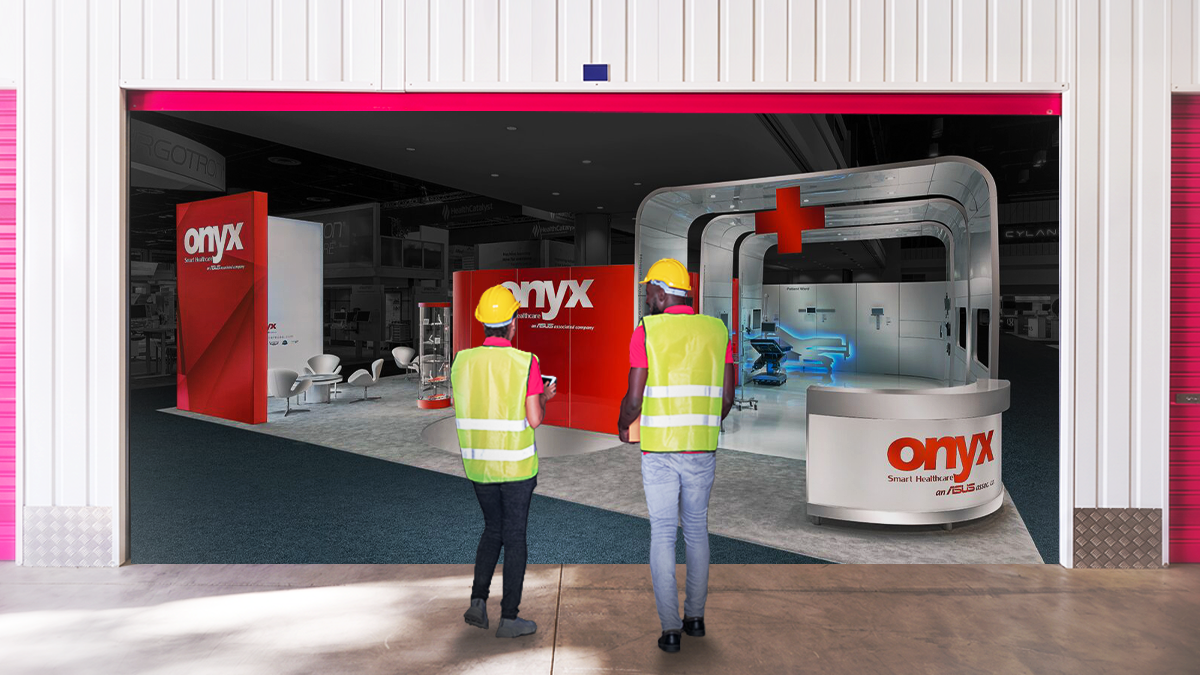
What Is Healthcare-Grade Exhibit Storage?
Healthcare-grade exhibit storage is warehousing built to protect what a standard self-storage unit was never designed to handle: a custom booth structure, sensitive demo equipment, calibrated devices, and graphics that need to look exactly as approved the next time they roll onto a show floor under the kind of climate control, security, and handling protocols that pharma and medical device companies require but most other industries never have to think about.
It sounds like a minor line item, but it isn't one. If your exhibit program includes a custom or modular booth, any kind of product demonstration hardware, or equipment that has to stay calibrated between shows, where and how that gets stored between RSNA in the fall and HIMSS in the spring directly affects your budget, your equipment's lifespan, and how your booth performs the next time it goes up.
Why Does Healthcare Exhibit Storage Cost More Than Standard Storage?
A few factors compound, and together they explain the price.
Climate control isn't optional. Most self-storage facilities aren't climate-controlled, and temperature swings and humidity cause graphic degradation, hardware corrosion, and structural damage to exhibit components over time, true for any industry's exhibit, but the stakes are higher for healthcare booths because the fabric graphics often carry FDA-mandated fair-balance text and risk disclosures that have to stay legible and exactly as approved. A faded or peeling panel isn't just a cosmetic problem; it can become a compliance one.
Sensitive equipment requires more than a shelf. Medical device demo units, imaging hardware, and calibrated instruments don't store like a folding table. The same environmental discipline that governs medical equipment storage in clinical and warehouse settings generally continuous temperature and humidity monitoring with logged alarms, OEM-specified storage conditions for high-value devices, and security appropriate to equipment that can be worth hundreds of thousands of dollars carries over to exhibit demo units that need to perform flawlessly on a show floor after months of storage. A device that drifts out of calibration while sitting in a warehouse doesn't just need a tune-up; depending on the equipment, it may need to be recalibrated and re-documented before it can be used in a regulated demo environment at all, consistent with FDA calibration requirements under 21 CFR Part 820, which call for routine calibration per manufacturer instructions and complete documentation of the process.
Professional exhibit storage is active management, not passive warehousing. At the high end, storage includes itemized cataloging of every crate and component, barcode or RFID tracking, pre-show and post-show condition inspections with written reports, and on-demand refurbishment. For a healthcare exhibit, that documentation trail carries more weight than it would for a typical consumer brand booth, since show-site graphics and any displayed product claims may need to be defensible if questioned later.
The market prices all of this in. General trade show storage costs scale with exhibit size and service level, smaller inline exhibits at a basic commercial warehouse cost meaningfully less than large island exhibits stored at a full-service exhibit house with active inventory management. Layer in the climate, security, and equipment-handling standards that healthcare and medical device programs typically require, and healthcare-grade storage tends to land toward the higher end of that range, especially for large island exhibits or programs that include demo hardware.
What Does That Add Up to Over Time?
Run the math across a full ownership cycle, and the picture starts to look different from what it did on a per-month basis.
Storage alone, compounded over a three-to-five-year ownership cycle, regularly runs into the tens of thousands of dollars for a mid-to-large healthcare exhibit, and that's before factoring in the pull-and-prep fees many exhibit houses charge every time the booth comes out of storage, the refurbishment costs when graphics or components have degraded, or the cost of recalibrating demo equipment that's been sitting idle.
Most healthcare exhibitors display their booths for a handful of weeks each year. The other ten-plus months, it's depreciating in a warehouse, generating a monthly fee, and accumulating the kind of wear that eventually surfaces as a refurbishment bill.
Is There a Way to Eliminate the Cost Without Sacrificing Quality?
There is, and it comes down to one structural decision rather than a list of tactics. The real question is whether you own the exhibit or simply access it.
Ownership makes storage non-negotiable. The exhibit has to live somewhere between shows, and someone pays for that somewhere every month, whether the booth is in use or not. The fee doesn't pause because the show calendar is light that quarter.
An access-based model changes the underlying economics. Instead of purchasing and warehousing a custom build, a healthcare brand accesses a reconfigurable exhibit system that's maintained, stored, and refreshed by the exhibit partner. Storage stops appearing on your invoice because you're never the one storing it. The same applies to refurbishment and recalibration costs incurred when equipment sits unused for months: when the exhibit and its components are actively managed and reused across multiple clients and shows, that maintenance burden falls to the partner's operating model rather than being passed through to you every month.
There's a sustainability case here as well, and it's structural rather than aspirational. Every healthcare exhibit sitting in storage represents square footage, energy for climate control, and raw materials supporting only a few weeks of use per year. A circular model where exhibit components are reused and reconfigured across shows and clients rather than built once, stored indefinitely, and eventually scrapped reduces that footprint by design, not by intention. For healthcare brands with genuine sustainability commitments, that's a more credible story than a one-off "green" material swap.
What Should You Ask Your Exhibit Partner About Storage?
A few questions tend to surface the real cost picture quickly, and storage fees are more negotiable than most exhibitors assume, particularly when renegotiating an existing contract or asking what add-on services like 24-hour security or duplicate insurance coverage are actually being charged for:
- What's our actual monthly storage rate, and what's included: climate control, security, inventory tracking, and condition inspections?
- How much have we spent on storage and pull-and-prep fees over the past 12 months?
- If we're storing demo equipment, is the facility maintaining manufacturer-specified environmental conditions, and is calibration tracked and documented?
- What happens to our graphics and components during long storage gaps, and what does the refurbishment process cost?
- What would it look like to stop owning and storing the exhibit altogether?
That last question tends to reframe the entire conversation.
Where Exhibit Happy by Steelhead Comes In
Storage fees have a way of accumulating quietly until someone finally adds up twelve months of invoices and asks why.
Exhibit Happy by Steelhead is built on an access model specifically so healthcare brands don't have that conversation. No owned exhibit means no monthly storage bill, no surprise refurbishment costs from equipment that sat too long in a warehouse, and no recalibration scramble before the next show. Pair that with a circular-economics approach to how exhibit components are reused and reconfigured, and storage stops being a hidden cost of doing business.
Your booth should be working for you at the next show, not sitting in a warehouse costing you money in between.
Frequently Asked Questions
What makes exhibit storage "healthcare-grade" specifically? It generally means climate control tight enough to protect FDA-regulated graphics and sensitive demo equipment, security appropriate to high-value medical devices, and documented handling protocols, condition reports, calibration tracking, and chain-of-custody records that a standard commercial storage unit doesn't provide.
How much does healthcare exhibit storage typically cost per month? Costs scale with exhibit size and service level, ranging from modest fees for small inline exhibits at a basic commercial warehouse to several hundred dollars or more per month for large island exhibits at a full-service exhibit house. Healthcare-specific handling, climate control, and equipment requirements typically push costs toward the higher end of that range.
Does medical device demo equipment really need special storage? Often, yes. Equipment that requires calibration under FDA quality system regulations can drift out of tolerance if stored improperly, and high-value imaging or surgical demonstration hardware needs the same environmental monitoring and security it would receive in active clinical use.
What happens if exhibit graphics degrade in storage? Beyond the appearance issue, degraded fair-balance text or risk disclosures on pharmaceutical exhibit graphics can become a compliance issue, since that text has to remain exactly as approved and legible at the required sightlines.
Is renting or accessing an exhibit actually cheaper than owning one long-term? For most healthcare brands exhibiting at a handful of shows per year, yes, once storage, refurbishment, and pull-and-prep fees are factored into the true cost of ownership rather than just the upfront build price.
How does an access-based exhibit model eliminate storage costs? Because the brand never takes ownership of the physical exhibit, there's no asset requiring a dedicated storage line item between shows. That responsibility, along with maintenance and refurbishment, sits with the exhibit partner instead.
Sources
- RSNA 2026 Scientific Assembly & Annual Meeting — Radiological Society of North America. https://www.rsna.org/annual-meeting
- HIMSS Global Health Conference & Exhibition. https://www.himssconference.com/
- Medical Equipment Storage and Warehousing: Maintaining Compliance When Your Devices Are Between Deployments — STSI. https://spectransport.com/blog/medical-equipment-storage-and-warehousing
- Medical Equipment Device Calibration — Allometrics. https://allometrics.com/medical-equipment-device-calibration/
- Storage Wars — Exhibitor Online. https://www.exhibitoronline.com/topics/article.asp?ID=2774
- Exhibit Happy by Steelhead. https://exhibithappy.com/
Note: Cost figures above reflect general trade show and medical equipment storage industry benchmarks, since healthcare-specific public benchmarking data for exhibit storage specifically is limited; figures are presented as ranges to reflect that variability. Regulatory information regarding calibration and FDA requirements reflects general guidance as commonly summarized by industry sources, not direct legal or regulatory advice. Healthcare companies should confirm current requirements with their own regulatory and compliance counsel.