


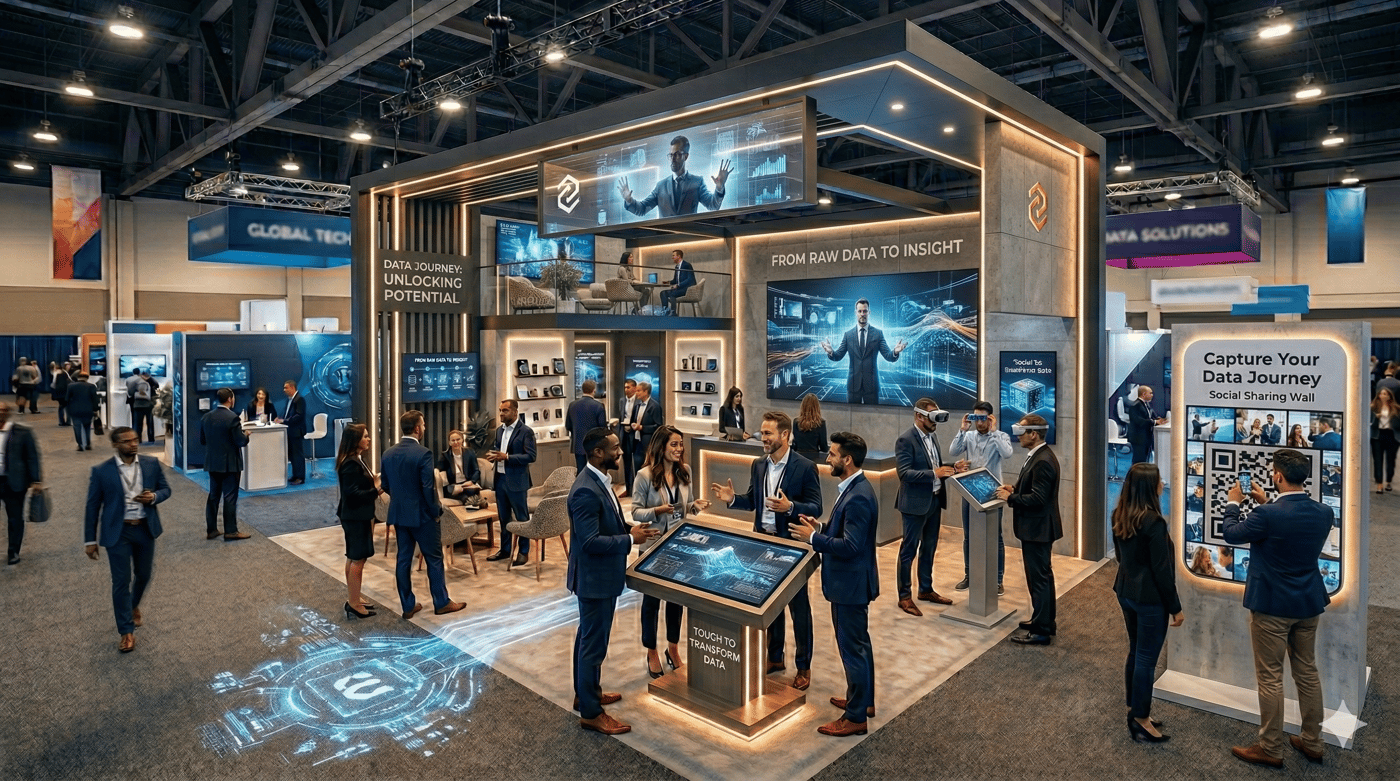
Trade show floors are louder, faster, and more competitive than ever. For today’s event manager, success isn’t just about square footage — it’s about designing immersive trade show booth experiences that invite interaction, spark emotion, and drive measurable engagement.
In the B2B space, 72% of trade show attendees are more likely to buy from exhibitors they meet at a show — showing the value of meaningful in-person interactions facilitated by well-designed booth experiences.
As brands shift toward experiential trade show marketing, immersive environments are becoming the standard — not the exception. If you’re already thinking about strategy, performance metrics, and how your booth contributes to pipeline, this is where design becomes a competitive advantage.
Immersive booth design isn’t about adding more screens or bigger structures. It’s about aligning strategy, space, and interaction from the ground up.
If you’re evaluating how to improve engagement at your next event, this guide breaks down the core principles behind immersive trade show booth experiences — and how to build them intentionally.
What Are Immersive Trade Show Booth Experiences?
Immersive trade show booth experiences are intentionally designed environments that engage multiple senses, encourage participation, and turn attendees into active participants.
Unlike static displays, immersive booths combine:
-
Environmental storytelling
-
Interactive touchpoints
-
Strategic lighting and layout
-
Staff choreography
-
Content capture moments
They are often supported by smart structural planning, including flexible exhibit design for multiple shows, allowing brands to adapt experiences across a full event calendar without starting from scratch each time.
For event managers focused on ROI, immersive trade show booth experiences increase:
-
Booth traffic
-
Dwell time
-
Qualified conversations
-
Brand recall
-
Social sharing
In short, they turn space into strategy.
Why Immersion Drives Engagement
Industry research consistently shows that attendees prioritize booths that feel engaging and interactive. In an environment filled with visual noise, immersive trade show booth experiences create a pattern interrupt.
-
Capture attention quickly
-
Trigger emotional engagement
-
Encourage hands-on participation
-
Provide a reason to stay longer
If you’ve explored trade show performance metrics that actually matter, you know that dwell time and engagement quality often correlate directly with post-show pipeline impact. Immersion isn’t decorative — it’s performance-driven.
Principle 1: Start With a Clear Experience Objective
Before designing structure, start with strategy.
Ask:
-
What should attendees feel?
-
What action should they take?
-
What business goal does this support?
-
How will we measure engagement?
Immersive trade show booth experiences are not built around décor. They are built around objectives.
For example:
-
Repositioning your brand? Design a narrative-driven environment.
-
Driving demos? Build natural pathways that funnel traffic toward interaction areas.
If you’ve reviewed strategies for optimizing trade show spend, you already understand that experience design must justify investment. Immersion should directly support measurable outcomes.
Principle 2: Design for Flow, Not Just Form
Many booths are designed for aesthetics but fail in movement and usability. Immersive trade show booth experiences prioritize flow.
Consider:
Entry Points
Is your booth open and accessible from multiple angles?
Does the layout guide attendees from curiosity to engagement?
Is there a central feature drawing traffic inward?
Is there a clear next step — demo sign-up, content download, conversation?
This is where custom exhibit rental solutions can be especially powerful. Flexible structures allow you to reconfigure layouts to prioritize behavior — not just appearance.
An immersive booth should feel intuitive. Attendees shouldn’t wonder where to go next.
Principle 3: Engage Multiple Senses
Immersive trade show booth experiences stimulate more than sight.
Beyond graphics and signage, consider:
-
Dynamic lighting to shape mood
-
Textural materials that invite touch
-
Directional sound elements
-
Interactive digital interfaces
-
Hands-on product testing
Multi-sensory engagement increases memory retention. The more senses involved, the stronger the brand imprint.
When paired with thoughtful experiential trade show marketing ideas, sensory design helps your booth stand apart in a crowded hall.
Principle 4: Make Interaction the Centerpiece
Immersion requires participation.
Instead of:
Focus on:
-
Live demonstrations
-
Guided experiences
-
Gamified learning moments
-
Touchscreen exploration
-
Interactive storytelling walls
When attendees actively participate, they internalize your message.
If your strategy includes turning your booth into a content engine, interaction becomes even more important. Interactive moments are often the most shareable — extending reach beyond the show floor.
Principle 5: Align Staff With the Experience
Even the most visually compelling immersive trade show booth experiences will underperform without aligned staff.
Your team should:
-
Understand the experience journey
-
Guide attendees intentionally
-
Initiate engagement
-
Reinforce key messaging
-
Capture qualified insights
Staff behavior should reflect the energy of the booth. If the design feels immersive but the engagement feels transactional, the experience breaks.
Principle 6: Design for Amplification
Modern immersive trade show booth experiences don’t end at the booth boundary.
Ask:
-
Is there a photo-worthy moment?
-
Are we encouraging user-generated content?
-
Can attendees easily share what they experience?
-
Are we collecting testimonials or video snippets?
With social sharing increasingly shaping brand visibility, your booth should contain at least one visually compelling moment designed for amplification.
This is where immersive design connects directly to broader experiential trade show marketing strategy.
Principle 7: Measure Immersion Against Performance
Immersion should drive outcomes — not distract from them.
Track:
-
Dwell time
-
Engagement interactions
-
Demo completions
-
Lead quality
-
Social mentions
-
Pipeline attribution
If you’re reviewing trade show performance metrics, immersion often influences upstream indicators that impact downstream revenue.
The most effective immersive trade show booth experiences blend emotional engagement with operational clarity.
Common Pitfalls to Avoid
Even well-intentioned immersive trade show booth experiences can fall short. Watch for:
-
Overcomplicating technology
-
Ignoring traffic flow
-
Designing without KPI alignment
-
Neglecting staff training
-
Forgetting follow-up strategy
Immersion should feel seamless for attendees — even if it requires careful coordination behind the scenes.
Building Immersive Trade Show Booth Experiences From the Ground Up
To recap, immersive trade show booth experiences should follow this framework:
-
Define the objective
-
Map the attendee journey
-
Design for sensory engagement
-
Integrate meaningful interaction
-
Train staff intentionally
-
Plan for content amplification
-
Align with measurable KPIs
From there, structure becomes a tool — not the strategy itself.
For event managers operating at the middle of the funnel, this is where differentiation happens. You’ve already committed to exhibiting. Now the focus shifts to performance.
Immersive trade show booth experiences give your brand an edge by transforming attention into engagement — and engagement into measurable results.
Final Takeaway
Immersive trade show booth experiences aren’t about adding more elements. They’re about aligning strategy, design, interaction, and measurement from the start.
When done correctly, your booth becomes more than a footprint — it becomes a destination.
If you’re evaluating how to elevate your next event, contact us to start by designing immersion from the ground up—and ensure every design decision connects to performance.