


Published November 4, 2026
The exhibit floor has moved decisively from broadcast to experience. Across 2026's biggest trade shows, scripted product walkthroughs gave way to live problem-solving, AI that visitors could try, spaces that invite people to linger, and booths built around one sharp idea.
We saw that shift firsthand. At Exhibit Happy by Steelhead, we design, build, and pre-stage custom rental exhibits in Las Vegas, and our team spent 2026 embedded on the floors of the industry's biggest shows, from CES to G2E. Our 2026 Exhibit Trend Report captures what changed.
That shift raises the bar at CES, where more than 4,100 exhibitors competed for attention in 2026. Here are the nine trends we saw take hold and what you can still plan differently for CES.
The Quick Answer
- Proof beats presentations. Hands-on demos and AI that visitors can try are replacing the scripted product walkthrough.
- Clarity wins the aisle. One sharp idea stands out more than a bigger build, and LED now works as part of the architecture.
- Comfort and flow matter. Spaces that invite people to linger, and a planned path from discovery to private meetings, give the right conversations room to happen.
- The booth works beyond the show. Design for the camera, capture leads through participation, and build modular so the booth can change with your product.
Why Does CES Raise the Bar for Consumer Tech Booths?
CES 2027 runs January 6 to 9 in Las Vegas, and it puts very different audiences on the same show floor. According to the Consumer Technology Association's audited figures for CES 2026, the event drew 148,392 participants. Senior-level executives accounted for 52% of attendees, and 7,037 media representatives, content creators, and industry analysts covered the show. For your booth, that means making room for different conversations, from a business case for an executive to a clear story the media can share.
Getting their attention is only the first step. Your exhibit also needs to give them a reason to stay. In its roundup of the most engaging CES 2026 booths, Event Marketer described experiences that "were less about showstoppers and 4D thrill rides, and more about hidden gems and deep engagement." For consumer tech brands, the design opportunity is to help visitors experience the product, understand its value, and ask questions that lead to a useful conversation.
9 Trade Show Booth Design Trends for Consumer Tech Brands
1. Proof Over Presentations
The scripted, rep-led product walkthrough is fading, and booths built around live problem-solving are taking its place. Attendees have sat through enough polished decks to tell a rehearsed pitch from a real result. Across the shows our team covered in 2026, the hero moment wasn't a feature reveal. It was the visible solving of a problem the visitor walked in carrying, which is why square footage is moving out of seating banks and into solution stations.
Attendees agree. In Event Marketer's EventTrack 2026 study, 56% of trade show attendees said they would add more demos if they designed a brand's booth. When a booth made attendees more inclined to buy, the top reasons were understanding the product (62%), meeting with people who could discuss it (57%), and trying it (56%).
At CES 2026, one autonomous driving brand used an open layout to make attendees comfortable with the future of autonomous driving. Event Marketer summed it up in two words: "Hands on." Visitors could step inside to hear why real riders love the experience or watch the autonomous driver handle a range of scenarios. To make demos work in a busy hall, plan each station around:
- A real scenario attendees can try. Build each station around a problem attendees bring with them, and let them use the product to solve it.
- Someone who knows the product. Staff every station with a person who can answer questions and go beyond the demo.
- Room to engage. A demonstration needs room for people to gather and see, so leave open space around each station instead of filling every square foot.
- The right setup. Plan a work surface, a screen for viewing, lockable storage under the demo, and power for every device.
- Clear sightlines. Make sure people can see the product, and other attendees using it, from the aisle.
- A test run at pre-staging. Walk every station before the booth ships to check sightlines, adjust demo placement, and make sure visitors have room to engage.
2. AI That Visitors Can Experience
The exhibitors who stood out put AI inside the booth experience instead of just talking about it. Booth games used to be the crowd magnet that pulled people toward the real demo. Now the game is the demo. Challenges that adapt to a visitor's skill level, quizzes that branch by role, and scenarios that put the AI's capability in the visitor's hands let people leave knowing the product works because they just used it.
That distinction matters at CES, where Event Marketer noted that "AI was ubiquitous on this show floor, but the best storytellers broke through with design choices and demos that offered ah-ha moments." Event Marketer also highlighted a wellness tech brand's "My Wellness Portrait" AI photo activation, which turned each visitor's likeness into part of a digital collage. Design the station so the AI responds to the person in front of it, and keep someone nearby to answer the questions it raises. As we've written about how AI is actually being used in events today, the approach that works is simple: humans lead, AI accelerates.
3. Lead Capture Through Participation
Game mechanics are becoming the lead capture engine rather than a crowd trick. Challenges, leaderboards, and QR-gated registration are replacing the badge scan as the main way to collect data. That participation also gives your team context for follow-up: who a visitor is, what they care about, and how engaged they were.
Our 2026 What's In & What's Out guide puts transparent, opt-in, value-first lead capture on the "in" list and "collect everything" scanning on the "out" list. The exhibitors doing this well design the game alongside the CRM hand-off, staff scripting, and post-show follow-up, instead of bolting it on after the booth is built.
4. One Sharp Idea
As our Creative Director, Clinton Honn, points out, a lot of environments become a competition over who can build the biggest structure or the largest LED wall. But attendees can usually tell the difference between a booth that is expensive and one that is thoughtfully designed. Our trend report saw the same thing on the show floor: judges and buyers alike rewarded conceptual clarity as much as visual ambition, and the booths that held attention carried one idea through the layout, graphics, lighting, and staff.
A good test is whether you can describe your booth concept in one sentence and defend it against every "could we also add." Anything that distracts from that idea gets cut. At CES 2026, that kind of clarity stood out even in smaller booths. Event Marketer praised one legacy camera brand's smaller-scale booth for telling "an iconic story with unmistakable iconography," calling it a reminder that legacy brands can dial up the volume "even on the busiest of floors."
Getting there takes restraint. Clinton's approach starts with a controlled palette, disciplined branding, and strong focal moments, so your hero product doesn't compete with everything around it. In his words, "If everything is screaming for attention, nothing is." On Inside Exhibit Happy, he walks through how our design team uses lighting, texture, and materials to shape how a booth feels.
Planning your CES 2027 booth? Let's talk through which of these trends fit your goals.
5. Spaces That Invite People to Linger
More exhibitors are designing for how a booth feels, so the right conversation has time to happen. As Clinton puts it, "People feel something before they consciously understand it." Soft seating, ambient lighting, warm materials, semi-private lounge pods, and concierge-style staffing make the booth a place to stay, not a place to stop.
Comfort also depends on who the space is built for. Clinton asks whether a booth's staff are positioned as "guides instead of gatekeepers," and whether the space gives quieter visitors a way in, since many activations are built only for the most outgoing person in the aisle.
Our 2026 What's In & What's Out guide calls this designing for real humans: accessible layouts, better acoustics, calmer lighting, and clear wayfinding. Even acoustics can come down to a single design detail, like the sound-buffering panels overhead that Event Marketer noticed at one CES 2026 booth.
6. LED as Architecture
LED has moved from a display on the wall to the wall itself. Floor-to-ceiling walls, ceiling canopies, and content zones can change by session, audience, or time of day, so the same booth can present a completely different environment for a morning demo and an afternoon executive reception. Programmable surfaces also turn a mid-show messaging change into a file swap instead of a reprint.
At CES 2026, Event Marketer saw transparent, see-through screens used throughout the show, including one automotive exhibit where they layered information about the components over the product without breaking sightlines. Use transparency with care, though. In EventTrack 2026, transparent walls ranked last among the elements attendees would add to a booth: only 31% wanted more, and 27% wanted less. As our guide to technology-enabled trade show booths puts it, large-format displays should enhance storytelling, not overwhelm it.
7. Orchestrated Journeys and Protected Meetings
The award-winning booths we saw in 2026 were sequenced, with an entry threshold, a discovery zone, a demonstration moment, and a clear next step, each with its own job. A booth without a journey is just a room.
Our trend report calls the commercial version of this the two-speed floor plan: an open, high-energy discovery zone up front, with protected, scheduled meeting space behind it, so the crowd your demos attract doesn't swallow the conversations that lead to deals. The demand is there. Event Marketer reported that "private showcases and lounges are growing in popularity" at CES, and 43% of trade show marketers plan to lean into more facilitated sales meetings in the booth in 2026.
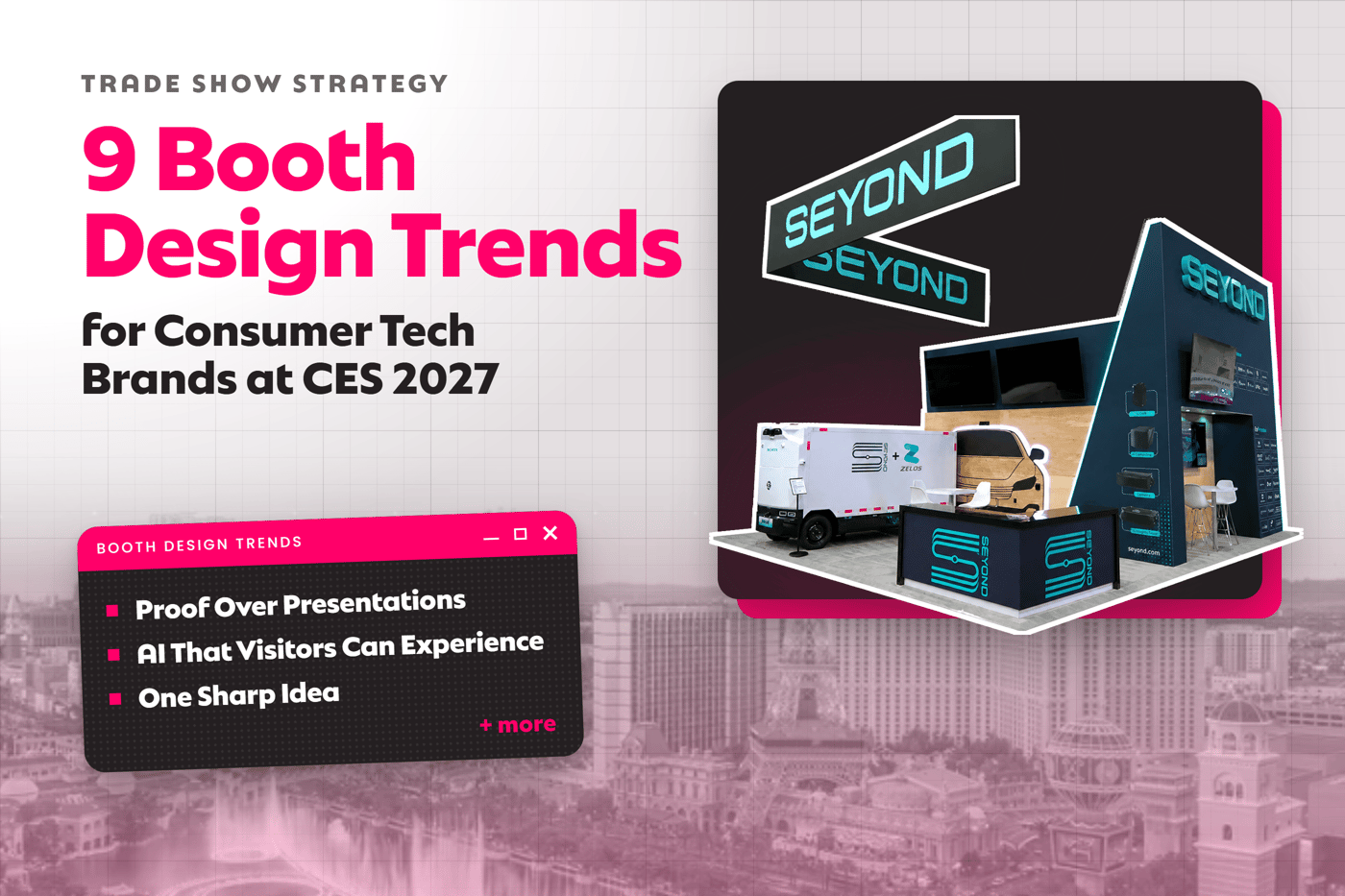
The design work is in the hand-off, with staff roles, routing cues, and booking tools that move a qualified attendee from the open floor to a meeting without friction. On a compact footprint, a second level can make room for those meetings. Seyond's CES presence has evolved into a refined, double-decker VIP experience built for high-value conversations, and its booth at CES 2026 kept that second level. Here's a look.
8. The Booth as a Campaign Asset
The booth is becoming the content hub for a campaign that runs before, during, and after the show, so design decisions have to work for the camera as well as for visitors on the floor. As our trend report puts it, the booth has to serve two audiences at once: the visitor walking through it, and the remote audience seeing it through photos, videos, and campaign content.
At CES, that remote audience starts with the media, content creators, and analysts covering the show, and attendees add to it. In EventTrack 2026, 62% of trade show attendees captured photos or video in booths, and 87% shared their show experience with people who weren't there. Social capture zones ranked lower with attendees, though, since only 38% would add more of them. Treat the week on the floor as the production shoot, with camera angles, lighting, and hero-shot zones designed alongside the floor plan, not after.
9. Modular-First Booths
Single-use custom builds are giving way to modular systems. Our trend report frames it as building for the circuit, not the show, with one system planned across three to five shows, scaled from a 10x10 inline to an island, and reconfigured by market.
That flexibility matters when a brand changes fast. Seyond's CES booth footprints shifted dramatically year over year, and when the company announced a full rebrand just one month before CES, its booth still had to debut the new identity on one of the industry's biggest stages.
Our Access Model gives you a custom-designed exhibit built with reusable components we own, maintain, and store between shows, so you skip the storage and upkeep that come with owning. Reuse also matters to the people walking the floor, since 85% of trade show attendees care about sustainability. As the first B Corp-certified exhibit house in North America, we divert 90% of our exhibit materials from landfills.
What Should You Plan Differently for CES?
Trends only help if they fit your goals and your venue, so a few decisions come first:
- Start with the outcome. Decide whether CES is about a launch, executive meetings, or press coverage, and choose the trends that serve that goal. Our guide to designing a booth around measurable goals walks through what to define first.
- Read your venue's exhibitor manual. CES publishes separate exhibitor manuals for each venue, including LVCC and Venetian Expo, so check the rules for anything your design depends on, like a second level, a hanging sign, or sound from a demo.
- Map power and internet for every demo and screen. Both are ordered through the show and billed separately, so they belong in your 2027 booth budget.
- See it fully built before it ships. Pre-staging lets you walk your booth, test your layouts, and make adjustments early. Our Las Vegas headquarters includes 50,000 square feet of pre-staging space, and we typically pre-stage one to two weeks before your booth ships to the show.
- Check your timeline. CES 2027 is about two months away, and we find the sweet spot to start a custom booth is four to six months before your show. If you're starting now, our guide to how far in advance to plan a custom exhibit explains what's still possible on a short timeline.
Where Exhibit Happy by Steelhead Comes In
Picking the right trends is only part of the work. Our Proven Design Process starts with your goals before we develop a rendering, our Price Guarantee locks the price of everything we provide once you approve the proposal, and our on-site team supports you from installation through dismantle.
Bring us your product plans for CES, even if some details are still under wraps or taking shape. We'll help you decide which trends are worth your square footage and design a booth that gives people a reason to stop, try, and talk. Book a Consultation to get started.
Frequently Asked Questions
What booth design trends should consumer tech brands plan for at CES 2027?
Based on what our team saw across 2026's biggest trade shows, the trends to plan around are hands-on demos over scripted presentations, AI that visitors can try, lead capture through participation, one sharp idea, spaces that invite people to linger, LED used as architecture, sequenced journeys with protected meeting space, booths designed for content, and modular systems that serve multiple shows.
What booth design works best for consumer technology companies?
The best consumer tech booths are built around one clear goal and hands-on demos. Build each demo station around a real scenario attendees can try, staff it with someone who knows the product, lead with one strong focal point instead of a crowded design, and protect space for meetings.
How do you demo products well in a busy trade show hall?
Build each station around a real scenario attendees can try, and staff it with someone who knows the product. Give people room to engage, keep clear sightlines from the aisle, and test every station at pre-staging before the booth ships.
What do attendees notice first in a consumer tech booth?
Attendees notice how a booth feels before they notice what it sells. As our Creative Director, Clinton Honn, puts it, "People feel something before they consciously understand it." Clarity, clean lines, and controlled lighting signal confidence, and an approachable space makes visitors feel welcomed in rather than overwhelmed.
Related Posts
- Technology-Enabled Trade Show Booths: What to Use (and What to Skip)
- Breaking Digital Ground in Trade Show Engagement
- How AI Is Actually Being Used in Events Today
Sources:
- Consumer Technology Association, "CES 2026 Audit Shows Four Percent Growth in Participation as Innovators Showed Up in Las Vegas" (March 31, 2026)
- CES, "Exhibit at CES 2027"
- CES, Exhibitor Manuals
- Event Marketer, "CES 2026: Editors' Picks for the Best of the Booth Experiences" (January 16, 2026)
- Event Marketer, "CES 2026: Editors' Picks for the Best Brand Showcases and Suites" (January 20, 2026)
- Event Marketer, "EventTrack 2026: Experiential Marketing Forecast & Benchmark Study" (survey of 517 brand marketers and 811 event attendees, June and July 2025; underwritten by Sparks)
- Exhibit Happy by Steelhead, "2026 Exhibit Trend Report"
- Exhibit Happy by Steelhead, "7 Things to Know About Reusable Booth Rentals"
- Exhibit Happy by Steelhead, "How to Budget for Trade Show Booth Costs in 2027"
- Exhibit Happy by Steelhead, "Trade Show Booth Trends 2026: What's In & What's Out"
- Exhibit Happy by Steelhead, Inside Exhibit Happy Episode 13, "When Design Becomes Choreography"
- Exhibit Happy by Steelhead, "Seyond's Evolution: A Case Study in Flexibility and Innovation"
- Exhibit Happy by Steelhead, Trade Show Booth Construction (Las Vegas facility and pre-staging)